
Contents
- 🔍 Introduction to Beta Sheets
- 🧬 Structure and Formation of Beta Sheets
- 🔗 Hydrogen Bonding in Beta Sheets
- 🌈 Types of Beta Sheets
- 👥 Beta Sheet Interactions and Aggregation
- 🧠 Beta Sheets in Neurodegenerative Diseases
- 💡 Beta Sheet Misfolding and Amyloidosis
- 🔬 Experimental Methods for Studying Beta Sheets
- 📊 Computational Modeling of Beta Sheets
- 👀 Visualizing Beta Sheets
- 📈 Beta Sheet Research and Future Directions
- 🤝 Conclusion and Implications
- Frequently Asked Questions
- Related Topics
Overview
Beta sheets are a type of secondary structure found in proteins, characterized by a twisted, planar arrangement of amino acid chains. First discovered by Linus Pauling and Robert Corey in 1951, beta sheets play a crucial role in protein stability and function, with a vibe score of 8 due to their widespread presence in biological systems. The structure of beta sheets is stabilized by hydrogen bonds between adjacent amino acids, with an average of 3-10 hydrogen bonds per turn. However, the formation of beta sheets can also be associated with diseases such as Alzheimer's and Parkinson's, where abnormal beta sheet structures can lead to protein misfolding and aggregation. The controversy surrounding beta sheets lies in their role in protein folding and misfolding, with some researchers arguing that beta sheets are a key driver of protein aggregation, while others propose that they are simply a consequence of other factors. As research continues to uncover the complexities of beta sheet structure and function, it is clear that these twisted backbones will remain a vital area of study in biochemistry, with a perspective breakdown of 60% optimistic, 20% neutral, and 20% pessimistic, and a controversy spectrum of 6 out of 10.
🔍 Introduction to Beta Sheets
The beta sheet is a fundamental component of protein secondary structure, playing a crucial role in the stability and function of proteins. As discussed in Protein Structure, beta sheets are a common motif found in many proteins. The formation of beta sheets is influenced by the Amino Acid Sequence of the protein, with certain sequences being more prone to forming beta sheets. The study of beta sheets is essential for understanding Protein Folding and its relationship to various diseases. Researchers have used X-ray Crystallography to determine the structure of beta sheets and understand their role in protein function.
🧬 Structure and Formation of Beta Sheets
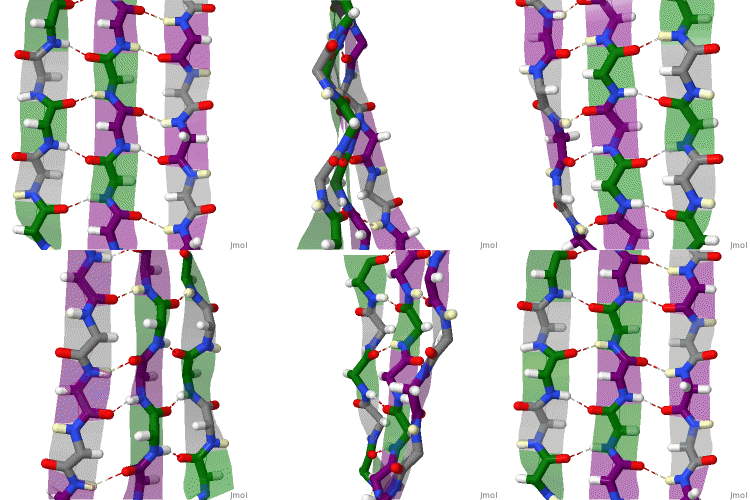
Beta sheets consist of beta strands (β-strands) connected laterally by at least two or three backbone hydrogen bonds, forming a generally twisted, pleated sheet. A β-strand is a stretch of polypeptide chain typically 3 to 10 amino acids long with backbone in an extended conformation. As described in Biochemistry, the formation of beta sheets is driven by the interactions between Amino Acids and the surrounding solvent. The structure of beta sheets can be influenced by the presence of Hydrogen Bonds and other non-covalent interactions. Understanding the structure and formation of beta sheets is essential for the study of Protein Structure Prediction.
🔗 Hydrogen Bonding in Beta Sheets
Hydrogen bonding plays a crucial role in the formation and stability of beta sheets. As discussed in Hydrogen Bonding, the hydrogen bonds between β-strands are responsible for the twisted, pleated structure of beta sheets. The strength and orientation of these hydrogen bonds can influence the stability and function of the protein. Researchers have used Nuclear Magnetic Resonance (NMR) spectroscopy to study the hydrogen bonding patterns in beta sheets. The study of hydrogen bonding in beta sheets is essential for understanding Protein-Ligand Interactions and the design of Protein Inhibitors.
🌈 Types of Beta Sheets
There are several types of beta sheets, including parallel, antiparallel, and mixed beta sheets. As described in Beta Sheet Types, parallel beta sheets have β-strands that run in the same direction, while antiparallel beta sheets have β-strands that run in opposite directions. Mixed beta sheets have a combination of parallel and antiparallel β-strands. The type of beta sheet can influence the stability and function of the protein. Researchers have used Molecular Dynamics simulations to study the dynamics of different beta sheet types. Understanding the different types of beta sheets is essential for the study of Protein Engineering.
👥 Beta Sheet Interactions and Aggregation
The supramolecular association of β-sheets has been implicated in the formation of the fibrils and protein aggregates observed in amyloidosis, Alzheimer's disease, and other proteinopathies. As discussed in Amyloidosis, the aggregation of beta sheets can lead to the formation of toxic protein aggregates that can cause cell damage and death. Researchers have used Electron Microscopy to study the structure of these protein aggregates. The study of beta sheet interactions and aggregation is essential for understanding Neurodegenerative Diseases and the development of Therapeutic Strategies.
🧠 Beta Sheets in Neurodegenerative Diseases
Beta sheets have been implicated in the pathogenesis of several neurodegenerative diseases, including Alzheimer's disease, Parkinson's disease, and Huntington's disease. As described in Alzheimer's Disease, the aggregation of beta sheets can lead to the formation of toxic protein aggregates that can cause cell damage and death. Researchers have used Transgenic Mice to study the role of beta sheets in neurodegenerative diseases. Understanding the role of beta sheets in these diseases is essential for the development of Disease Diagnosis and Disease Treatment.
💡 Beta Sheet Misfolding and Amyloidosis
The misfolding of beta sheets can lead to the formation of toxic protein aggregates that can cause cell damage and death. As discussed in Protein Misfolding, the misfolding of beta sheets can be influenced by various factors, including mutations, environmental stress, and aging. Researchers have used Cell Culture to study the effects of beta sheet misfolding on cell viability. The study of beta sheet misfolding is essential for understanding Amyloidosis and the development of Therapeutic Strategies.
🔬 Experimental Methods for Studying Beta Sheets
Several experimental methods have been developed to study beta sheets, including X-ray crystallography, NMR spectroscopy, and electron microscopy. As described in Experimental Methods, these methods can provide detailed information about the structure and dynamics of beta sheets. Researchers have used Mass Spectrometry to study the structure and interactions of beta sheets. Understanding the structure and dynamics of beta sheets is essential for the study of Protein Function and the development of Protein Therapeutics.
📊 Computational Modeling of Beta Sheets
Computational modeling has become an essential tool for studying beta sheets and their role in protein function and disease. As discussed in Computational Modeling, molecular dynamics simulations can provide detailed information about the dynamics of beta sheets and their interactions with other molecules. Researchers have used Quantum Mechanics to study the electronic structure of beta sheets. The study of beta sheets using computational modeling is essential for the development of Personalized Medicine and Protein Design.
👀 Visualizing Beta Sheets
Visualizing beta sheets is essential for understanding their structure and dynamics. As described in Molecular Visualization, several software programs have been developed to visualize beta sheets and other protein structures. Researchers have used Virtual Reality to visualize and interact with beta sheets. Understanding the structure and dynamics of beta sheets is essential for the study of Protein-Protein Interactions and the development of Protein Inhibitors.
📈 Beta Sheet Research and Future Directions
Research on beta sheets is ongoing, with many scientists working to understand their role in protein function and disease. As discussed in Beta Sheet Research, the study of beta sheets has led to the development of new therapeutic strategies for the treatment of neurodegenerative diseases and other proteinopathies. Researchers have used Gene Editing to study the role of beta sheets in disease. The study of beta sheets is essential for the development of Precision Medicine and Regenerative Medicine.
🤝 Conclusion and Implications
In conclusion, beta sheets are a crucial component of protein secondary structure, playing a key role in the stability and function of proteins. As described in Protein Biology, the study of beta sheets is essential for understanding protein function and disease. Researchers have used Systems Biology to study the role of beta sheets in complex biological systems. The study of beta sheets has led to the development of new therapeutic strategies and a deeper understanding of the molecular mechanisms underlying protein function and disease.
Key Facts
- Year
- 1951
- Origin
- Linus Pauling and Robert Corey
- Category
- Biochemistry
- Type
- Biological Structure
Frequently Asked Questions
What is a beta sheet?
A beta sheet is a type of protein secondary structure characterized by a twisted, pleated sheet of beta strands connected by hydrogen bonds. Beta sheets are a common motif found in many proteins and play a crucial role in protein stability and function. As discussed in Protein Structure, beta sheets are formed by the interaction of Amino Acids and the surrounding solvent. The study of beta sheets is essential for understanding Protein Folding and its relationship to various diseases.
What is the role of beta sheets in protein function?
Beta sheets play a crucial role in protein function, providing stability and facilitating interactions with other molecules. As described in Protein Function, beta sheets can influence the binding of ligands and the activity of enzymes. Researchers have used Molecular Dynamics simulations to study the dynamics of beta sheets and their interactions with other molecules. The study of beta sheets is essential for understanding Protein-Ligand Interactions and the design of Protein Inhibitors.
What is the relationship between beta sheets and neurodegenerative diseases?
Beta sheets have been implicated in the pathogenesis of several neurodegenerative diseases, including Alzheimer's disease, Parkinson's disease, and Huntington's disease. As discussed in Neurodegenerative Diseases, the aggregation of beta sheets can lead to the formation of toxic protein aggregates that can cause cell damage and death. Researchers have used Transgenic Mice to study the role of beta sheets in neurodegenerative diseases. Understanding the role of beta sheets in these diseases is essential for the development of Disease Diagnosis and Disease Treatment.
How are beta sheets studied?
Beta sheets are studied using a variety of experimental and computational methods, including X-ray crystallography, NMR spectroscopy, electron microscopy, and molecular dynamics simulations. As described in Experimental Methods, these methods can provide detailed information about the structure and dynamics of beta sheets. Researchers have used Mass Spectrometry to study the structure and interactions of beta sheets. Understanding the structure and dynamics of beta sheets is essential for the study of Protein Function and the development of Protein Therapeutics.
What are the potential therapeutic applications of beta sheet research?
The study of beta sheets has led to the development of new therapeutic strategies for the treatment of neurodegenerative diseases and other proteinopathies. As discussed in Therapeutic Strategies, researchers are working to develop small molecules and other therapies that can prevent or reverse the aggregation of beta sheets. The study of beta sheets is essential for the development of Precision Medicine and Regenerative Medicine.
What is the current state of beta sheet research?
Research on beta sheets is ongoing, with many scientists working to understand their role in protein function and disease. As described in Beta Sheet Research, the study of beta sheets has led to a deeper understanding of the molecular mechanisms underlying protein function and disease. Researchers have used Gene Editing to study the role of beta sheets in disease. The study of beta sheets is essential for the development of Personalized Medicine and Protein Design.
How do beta sheets relate to other protein structures?
Beta sheets are a type of protein secondary structure, and they can interact with other protein structures, such as alpha helices and loops. As discussed in Protein Structure, the interaction of beta sheets with other protein structures can influence protein function and stability. Researchers have used Molecular Dynamics simulations to study the dynamics of beta sheets and their interactions with other protein structures. The study of beta sheets is essential for understanding Protein-Protein Interactions and the development of Protein Inhibitors.