
Contents
- 🌐 Introduction to Dual Aspect Monism
- 💡 Historical Background: Neutral Monism and Dual-Aspect Theory
- 🔍 The Core Claims of Dual-Aspect Monism
- 👀 The Relationship Between Mind and Matter
- 🤔 Criticisms and Challenges to Dual-Aspect Monism
- 📚 Key Figures in the Development of Dual-Aspect Monism
- 📊 The Implications of Dual-Aspect Monism for Philosophy of Mind
- 🔮 The Future of Dual-Aspect Monism: Emerging Trends and Debates
- 📝 Conclusion: The Harmony of Mind and Matter
- 📚 Further Reading and Resources
- 👥 Community and Discussion: Engaging with Dual-Aspect Monism
- Frequently Asked Questions
- Related Topics
Overview
Dual aspect monism posits that the fundamental substance of the universe has two aspects: mental and physical. This perspective, influenced by philosophers like Baruch Spinoza and Bertrand Russell, attempts to reconcile the dichotomy between mind and matter. With a vibe rating of 8, dual aspect monism has been debated by prominent thinkers, including David Chalmers and Galen Strawson, who argue that this framework can provide a more unified understanding of reality. The concept has far-reaching implications for fields like psychology, neuroscience, and artificial intelligence, with some proponents claiming it can help resolve the hard problem of consciousness. However, critics argue that dual aspect monism lacks empirical evidence and is often too vague to be testable. As the philosophy continues to evolve, it remains a topic of interest, with a controversy spectrum rating of 6, reflecting the ongoing debates and disagreements among scholars. The influence flow of dual aspect monism can be seen in the work of contemporary philosophers like Philip Goff, who have built upon the ideas of earlier thinkers to develop new perspectives on the nature of reality.
🌐 Introduction to Dual Aspect Monism
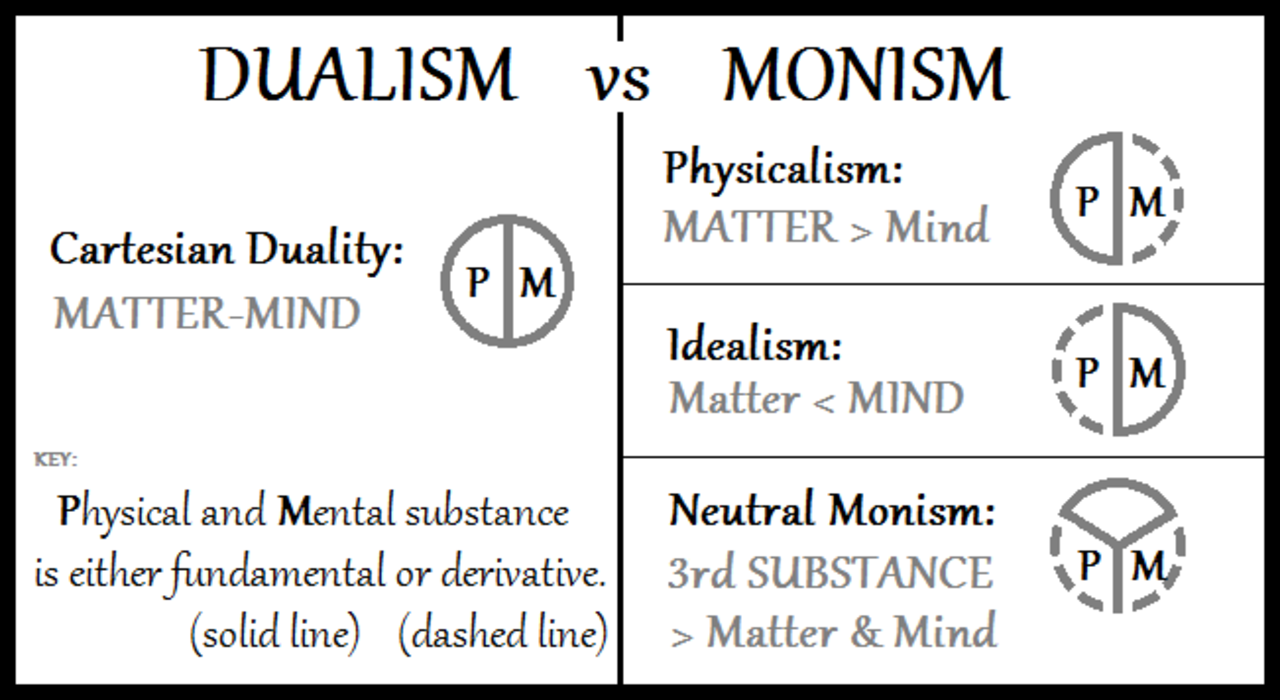
Dual aspect monism, also known as double-aspect theory, is a philosophical position that attempts to reconcile the mind-body problem by positing that the mental and physical are two aspects of, or perspectives on, the same underlying substance. This view is often contrasted with mind-body dualism, which posits the existence of two separate substances or entities. Dual aspect monism is also related to neutral monism, but the two theories have distinct differences. For example, neutral monism does not recognize the mental and physical aspects that are central to dual-aspect theory, instead focusing on the underlying reality that is neither mental nor physical. As discussed in the work of Baruch Spinoza, dual aspect monism has a long history in the philosophy of mind.
💡 Historical Background: Neutral Monism and Dual-Aspect Theory
The historical background of dual-aspect monism is complex and multifaceted. The theory has its roots in the work of Rene Descartes and John Locke, who both grappled with the nature of mind and matter. However, it was not until the development of neutral monism that the core claims of dual-aspect monism began to take shape. Neutral monism, as advocated by Bertrand Russell and Ernest Mach, posits that there is an underlying reality that is neither mental nor physical. Dual-aspect monism builds on this idea, but adds the crucial feature of mental and physical aspects that characterize the underlying entities. This is in contrast to epiphenomenalism, which views the mental as a byproduct of physical processes.
🔍 The Core Claims of Dual-Aspect Monism
The core claims of dual-aspect monism are centered on the idea that the mental and physical are two aspects of the same underlying substance. This view is often seen as a form of monism, which posits that there is only one fundamental substance or reality. Dual-aspect monism is distinct from dualism, which posits the existence of two separate substances or entities. The theory also has implications for our understanding of free will and moral responsibility. As discussed in the work of David Chalmers, dual aspect monism has been influential in the development of philosophy of mind.
👀 The Relationship Between Mind and Matter
The relationship between mind and matter is a central concern of dual-aspect monism. The theory posits that the mental and physical are two aspects of the same underlying substance, and that they are intimately connected. This view is often seen as a form of interactionism, which posits that the mental and physical interact and influence each other. However, dual-aspect monism is distinct from parallelism, which posits that the mental and physical run in parallel but do not interact. As discussed in the work of Galen Strawson, the implications of dual-aspect monism for our understanding of consciousness are significant.
🤔 Criticisms and Challenges to Dual-Aspect Monism
Dual-aspect monism is not without its criticisms and challenges. Some critics argue that the theory is too vague or unclear, and that it does not provide a sufficient account of the nature of mind and matter. Others argue that the theory is incompatible with physicalism, which posits that the physical world is the only fundamental reality. As discussed in the work of Jaegwon Kim, the relationship between dual-aspect monism and physicalism is complex and multifaceted. Despite these challenges, dual-aspect monism remains a influential and widely-discussed theory in the philosophy of mind.
📚 Key Figures in the Development of Dual-Aspect Monism
Several key figures have contributed to the development of dual-aspect monism. Baruch Spinoza is often seen as a precursor to the theory, as he argued that the mental and physical are two aspects of the same underlying substance. Bertrand Russell and Ernest Mach also played important roles in the development of neutral monism, which is closely related to dual-aspect monism. More recently, David Chalmers and Galen Strawson have been influential in the development of dual-aspect monism. As discussed in the work of John Searle, the implications of dual-aspect monism for our understanding of language and meaning are significant.
📊 The Implications of Dual-Aspect Monism for Philosophy of Mind
The implications of dual-aspect monism for philosophy of mind are significant. The theory provides a unique perspective on the mind-body problem, and offers a potential solution to the challenge of consciousness. Dual-aspect monism also has implications for our understanding of free will and moral responsibility. As discussed in the work of Daniel Dennett, the theory has been influential in the development of cognitive science.
🔮 The Future of Dual-Aspect Monism: Emerging Trends and Debates
The future of dual-aspect monism is uncertain, but the theory remains a widely-discussed and influential position in the philosophy of mind. Emerging trends and debates in the field are likely to continue to shape our understanding of dual-aspect monism and its implications. As discussed in the work of Christof Koch, the relationship between dual-aspect monism and integrated information theory is an area of ongoing research and debate.
📝 Conclusion: The Harmony of Mind and Matter
In conclusion, dual-aspect monism is a complex and multifaceted theory that attempts to reconcile the mind-body problem. The theory posits that the mental and physical are two aspects of the same underlying substance, and offers a unique perspective on the nature of mind and matter. As discussed in the work of Colin McGinn, the implications of dual-aspect monism for our understanding of philosophy of mind are significant. For further reading, see the work of David Chalmers and Galen Strawson.
📚 Further Reading and Resources
For further reading and resources on dual-aspect monism, see the work of Baruch Spinoza, Bertrand Russell, and David Chalmers. The theory has been influential in the development of philosophy of mind, and continues to be widely-discussed and debated. As discussed in the work of John Searle, the implications of dual-aspect monism for our understanding of language and meaning are significant.
👥 Community and Discussion: Engaging with Dual-Aspect Monism
The community and discussion surrounding dual-aspect monism are active and ongoing. The theory has been influential in the development of cognitive science and philosophy of mind, and continues to be widely-discussed and debated. For more information, see the work of Daniel Dennett and Christof Koch.
Key Facts
- Year
- 1662
- Origin
- Spinoza's Ethics
- Category
- Philosophy of Mind
- Type
- Philosophical Concept
Frequently Asked Questions
What is dual-aspect monism?
Dual-aspect monism is a philosophical position that attempts to reconcile the mind-body problem by positing that the mental and physical are two aspects of, or perspectives on, the same underlying substance. This view is often contrasted with mind-body dualism, which posits the existence of two separate substances or entities. As discussed in the work of Baruch Spinoza, dual aspect monism has a long history in the philosophy of mind.
How does dual-aspect monism relate to neutral monism?
Dual-aspect monism is related to neutral monism, but the two theories have distinct differences. Neutral monism posits that there is an underlying reality that is neither mental nor physical, but it does not recognize the mental and physical aspects that are central to dual-aspect theory. As discussed in the work of Bertrand Russell and Ernest Mach, neutral monism has been influential in the development of dual-aspect monism.
What are the implications of dual-aspect monism for philosophy of mind?
The implications of dual-aspect monism for philosophy of mind are significant. The theory provides a unique perspective on the mind-body problem, and offers a potential solution to the challenge of consciousness. Dual-aspect monism also has implications for our understanding of free will and moral responsibility. As discussed in the work of David Chalmers, the theory has been influential in the development of cognitive science.
Who are some key figures in the development of dual-aspect monism?
Several key figures have contributed to the development of dual-aspect monism. Baruch Spinoza is often seen as a precursor to the theory, as he argued that the mental and physical are two aspects of the same underlying substance. Bertrand Russell and Ernest Mach also played important roles in the development of neutral monism, which is closely related to dual-aspect monism. More recently, David Chalmers and Galen Strawson have been influential in the development of dual-aspect monism.
What are some criticisms of dual-aspect monism?
Dual-aspect monism is not without its criticisms and challenges. Some critics argue that the theory is too vague or unclear, and that it does not provide a sufficient account of the nature of mind and matter. Others argue that the theory is incompatible with physicalism, which posits that the physical world is the only fundamental reality. As discussed in the work of Jaegwon Kim, the relationship between dual-aspect monism and physicalism is complex and multifaceted.
How does dual-aspect monism relate to other philosophical theories?
Dual-aspect monism is related to a number of other philosophical theories, including neutral monism, mind-body dualism, and physicalism. The theory has also been influential in the development of cognitive science and philosophy of mind. As discussed in the work of Daniel Dennett and Christof Koch, the implications of dual-aspect monism for our understanding of language and meaning are significant.
What is the future of dual-aspect monism?
The future of dual-aspect monism is uncertain, but the theory remains a widely-discussed and influential position in the philosophy of mind. Emerging trends and debates in the field are likely to continue to shape our understanding of dual-aspect monism and its implications. As discussed in the work of Christof Koch, the relationship between dual-aspect monism and integrated information theory is an area of ongoing research and debate.