
Contents
- 🌎 Introduction to Earth History
- 🔍 The Geological Time Scale
- 🌟 The Emergence of Life
- 🌪️ Shaping the Planet's Surface
- 👥 Human Impact on the Environment
- 🔮 The Future of Our Planet
- 🤝 Conservation Efforts
- 📚 Related Topics and Deeper Reading
- 📊 Key Facts and Statistics
- 👀 Conclusion
- Frequently Asked Questions
- References
- Related Topics
Overview
Earth's history is a complex and fascinating narrative. The geological time scale provides a framework for understanding the major events that have shaped our planet, including extreme volcanism. As we explore the history of Earth, we gain insights into the intricate relationships between the planet's physical and biological systems, and how they have evolved over time. With a deeper understanding of Earth's history, we can better appreciate the delicate balance of our ecosystem and the importance of preserving it for future generations. The study of Earth's history is a field that draws on various disciplines to reconstruct the planet's past and inform our decisions about its future.
🌎 Introduction to Earth History
The history of Earth is a rich and complex topic. One of the key concepts in the field of geology is the idea that the Earth's geological features are the result of slow and continuous processes that have been occurring over millions of years. The Paleozoic Era is often referred to as the 'age of fish' due to the diversity of aquatic life that emerged during this time. The Hadean Eon was a time of significant geological activity.
🔍 The Geological Time Scale
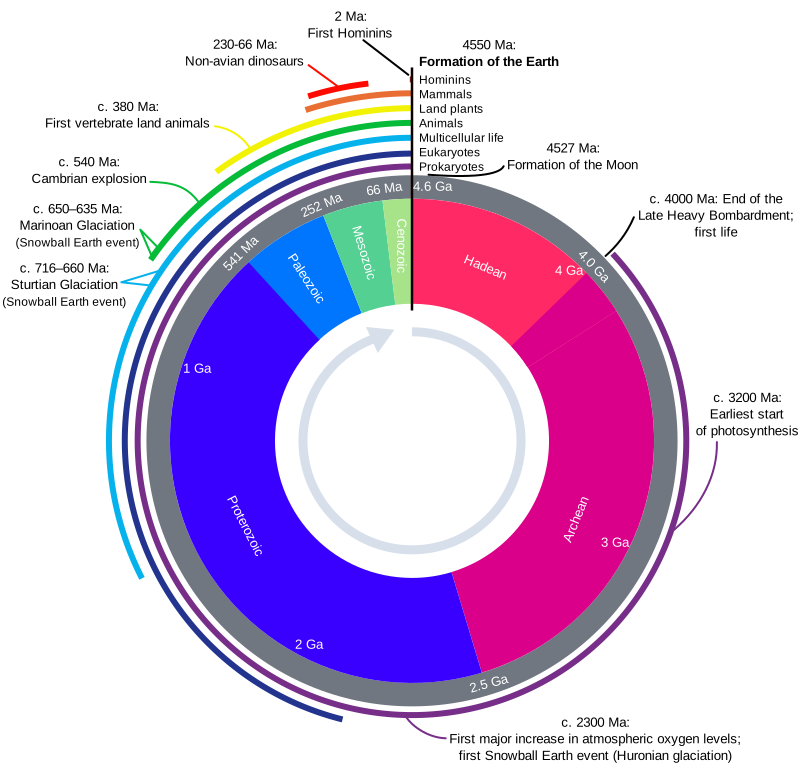
The geological time scale is a fundamental tool for understanding the history of Earth. Each of these divisions is characterized by significant events and features that have shaped the Earth's surface. Extreme volcanism has shaped the Earth's surface. The Mariana Trench is one of the deepest ocean trenches.
🌟 The Emergence of Life
The emergence of life on Earth is a fascinating and still somewhat mysterious topic. The first life forms were likely simple single-celled organisms that played a crucial role in shaping the Earth's environment. Over time, these simple life forms evolved into more complex organisms, such as plants and animals, which have had a profound impact on the planet's ecosystems.
🌪️ Shaping the Planet's Surface
The Earth's surface has been shaped by various geological processes. The study of the Earth's history can inform our decisions about how to manage the Earth's resources and protect its ecosystems.
👥 Human Impact on the Environment
The World Wildlife Fund is working to promote conservation and sustainability. Greta Thunberg is raising awareness about the importance of environmental protection.
🔮 The Future of Our Planet
As we look to the future, it is clear that the Earth's history will continue to shape our planet's ecosystems and environments. By studying the Earth's history, we can gain insights into the complex relationships between the planet's physical and biological systems, and how they have evolved over time.
🤝 Conservation Efforts
Conservation efforts are essential for protecting the Earth's ecosystems and environments. The World Wildlife Fund is working to preserve and restore natural habitats.
📊 Key Facts and Statistics
Key facts and statistics can provide a useful overview of the Earth's history. The Earth's ecosystems are diverse and complex, and are home to a wide range of plant and animal species.
👀 Conclusion
In conclusion, the history of Earth is a fascinating and complex topic. By exploring the Earth's history, we can gain insights into the complex relationships between the planet's physical and biological systems, and how they have evolved over time.
Key Facts
- Year
- 2025
- Origin
- Earth
- Category
- environment
- Type
- concept
Frequently Asked Questions
What is the history of Earth?
The history of Earth is a complex and fascinating narrative that spans over an unknown period of time.