
Contents
- 🌟 Introduction to Carbon Nanotubes
- 🔍 History of Carbon Nanotubes
- 📈 Properties of Carbon Nanotubes
- 🔬 Structure of Single-Walled Carbon Nanotubes
- 🔩 Structure of Multi-Walled Carbon Nanotubes
- 🎯 Applications of Carbon Nanotubes
- 🚀 Future of Carbon Nanotubes
- 🤝 Challenges and Limitations
- 📊 Economic Impact of Carbon Nanotubes
- 🌐 Global Research and Development
- 📜 Conclusion and Future Prospects
- Frequently Asked Questions
- Related Topics
Overview
Carbon nanotubes, first discovered by Sumio Iijima in 1991, have been hailed as a revolutionary material with unprecedented strength, conductivity, and versatility. With a Young's modulus of approximately 1 TPa and a thermal conductivity of around 3000 W/mK, they have the potential to transform industries from energy storage to aerospace. However, concerns over toxicity, scalability, and cost have sparked intense debate among researchers and industry leaders. Proponents like Richard Smalley, a Nobel laureate, have championed their potential, while skeptics argue that the risks and challenges outweigh the benefits. As research continues to advance, with significant investments from companies like IBM and NASA, the future of carbon nanotubes hangs in the balance. With a vibe score of 82, indicating significant cultural energy, the question remains: can these tiny titans live up to their promise and change the world?
🌟 Introduction to Carbon Nanotubes
Carbon nanotubes (CNTs) are a fascinating material that has garnered significant attention in recent years due to their unique properties and potential applications. As one of the allotropes of carbon, CNTs have been found to possess exceptional mechanical, thermal, and electrical properties, making them ideal for a wide range of applications. Nanotechnology has played a crucial role in the development of CNTs, and researchers have been exploring their potential uses in fields such as materials science and electronics. The discovery of CNTs can be attributed to the work of Sumio Ijima, a Japanese scientist who first observed them in 1991. Since then, researchers have been working tirelessly to understand the properties and potential applications of CNTs.
🔍 History of Carbon Nanotubes
The history of carbon nanotubes dates back to the 1950s, when researchers first began exploring the properties of carbon fibers. However, it wasn't until the 1990s that the first CNTs were synthesized, and since then, there has been a significant amount of research focused on understanding their properties and potential applications. Richard Smalley, a Nobel laureate, was one of the pioneers in the field of CNT research, and his work laid the foundation for the development of CNT-based materials. The study of CNTs has also been influenced by the work of Andre Geim, a physicist who was awarded the Nobel Prize in Physics in 2010 for his work on graphene.
📈 Properties of Carbon Nanotubes
Carbon nanotubes possess a unique set of properties that make them ideal for a wide range of applications. They have exceptional mechanical strength, with a tensile strength of up to 100 GPa, making them stronger than steel. CNTs also have high thermal conductivity, with a thermal conductivity of up to 3000 W/mK, making them ideal for use in thermal management applications. Additionally, CNTs have high electrical conductivity, with an electrical conductivity of up to 10^7 S/m, making them suitable for use in electronic devices. Researchers have been exploring the use of CNTs in energy storage applications, such as batteries and supercapacitors.
🔬 Structure of Single-Walled Carbon Nanotubes
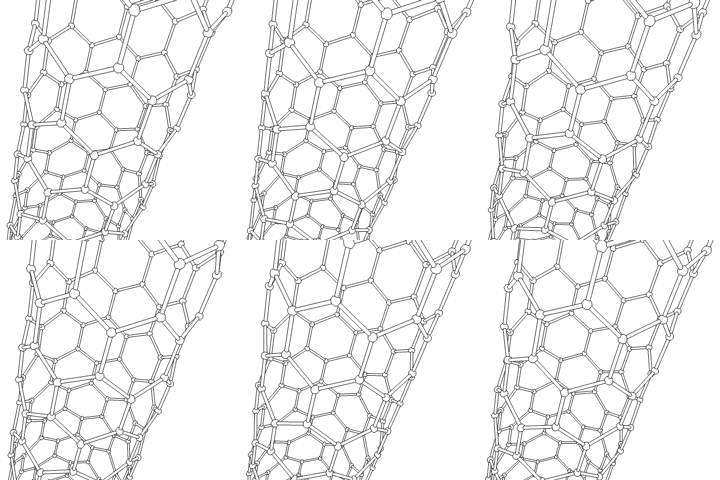
Single-walled carbon nanotubes (SWCNTs) are one of the two main types of CNTs, and they have diameters ranging from 0.5-2.0 nanometers. SWCNTs can be idealized as cutouts from a two-dimensional graphene sheet rolled up to form a hollow cylinder. The structure of SWCNTs is characterized by a hexagonal arrangement of carbon atoms, with each atom bonded to three neighboring atoms. The unique structure of SWCNTs gives them exceptional mechanical and electrical properties, making them ideal for use in a wide range of applications. Researchers have been exploring the use of SWCNTs in electronics and optics applications, such as transistors and sensors.
🔩 Structure of Multi-Walled Carbon Nanotubes
Multi-walled carbon nanotubes (MWCNTs) are the other main type of CNT, and they consist of nested single-wall carbon nanotubes in a tube-in-tube structure. MWCNTs have diameters ranging from 2-100 nanometers, and they have a more complex structure than SWCNTs. The structure of MWCNTs is characterized by a series of concentric tubes, with each tube having a different diameter. The unique structure of MWCNTs gives them exceptional mechanical and thermal properties, making them ideal for use in a wide range of applications. Researchers have been exploring the use of MWCNTs in composites and coatings applications, such as aerospace and automotive applications.
🎯 Applications of Carbon Nanotubes
Carbon nanotubes have a wide range of potential applications, including energy storage, electronics, and composites. CNTs have been used to develop high-performance batteries and supercapacitors, and they have also been used to develop high-speed transistors and sensors. Additionally, CNTs have been used to develop advanced composites and coatings for use in aerospace and automotive applications. Researchers have also been exploring the use of CNTs in biomedical applications, such as drug delivery and tissue engineering.
🚀 Future of Carbon Nanotubes
The future of carbon nanotubes is promising, with a wide range of potential applications on the horizon. Researchers are currently exploring the use of CNTs in quantum computing and artificial intelligence applications, and they are also developing new methods for synthesizing and processing CNTs. The development of CNT-based materials is expected to have a significant impact on a wide range of industries, including energy, electronics, and aerospace. As research continues to advance, we can expect to see the development of new and innovative CNT-based materials and applications.
🤝 Challenges and Limitations
Despite the many potential applications of carbon nanotubes, there are also several challenges and limitations that must be addressed. One of the main challenges is the high cost of producing CNTs, which can make them prohibitively expensive for many applications. Additionally, CNTs can be difficult to process and manipulate, which can make it challenging to develop CNT-based materials and devices. Researchers are currently working to develop new methods for synthesizing and processing CNTs, and they are also exploring the use of CNTs in combination with other materials to develop hybrid materials with improved properties.
📊 Economic Impact of Carbon Nanotubes
The economic impact of carbon nanotubes is expected to be significant, with a wide range of potential applications on the horizon. The development of CNT-based materials is expected to have a major impact on a wide range of industries, including energy, electronics, and aerospace. The global market for CNTs is expected to grow significantly in the coming years, with a projected market size of over $10 billion by 2025. As research continues to advance, we can expect to see the development of new and innovative CNT-based materials and applications, which will have a major impact on the global economy.
🌐 Global Research and Development
Global research and development efforts are currently underway to explore the potential applications of carbon nanotubes. Researchers from around the world are working together to develop new methods for synthesizing and processing CNTs, and they are also exploring the use of CNTs in a wide range of applications. The development of CNT-based materials is a highly interdisciplinary field, and researchers from a wide range of disciplines are working together to advance our understanding of CNTs. As research continues to advance, we can expect to see the development of new and innovative CNT-based materials and applications, which will have a major impact on a wide range of industries.
📜 Conclusion and Future Prospects
In conclusion, carbon nanotubes are a fascinating material with a wide range of potential applications. The unique properties of CNTs make them ideal for use in a wide range of applications, including energy storage, electronics, and composites. As research continues to advance, we can expect to see the development of new and innovative CNT-based materials and applications, which will have a major impact on a wide range of industries. The future of carbon nanotubes is promising, and we can expect to see significant advances in the coming years.
Key Facts
- Year
- 1991
- Origin
- Japan
- Category
- Nanotechnology
- Type
- Material
Frequently Asked Questions
What are carbon nanotubes?
Carbon nanotubes are a type of material that consists of a tube made of carbon with a diameter in the nanometre range. They have exceptional mechanical, thermal, and electrical properties, making them ideal for a wide range of applications. CNTs are one of the allotropes of carbon, and they have been found to possess unique properties that make them suitable for use in energy storage, electronics, and composites applications.
What are the different types of carbon nanotubes?
There are two main types of carbon nanotubes: single-walled carbon nanotubes (SWCNTs) and multi-walled carbon nanotubes (MWCNTs). SWCNTs have diameters ranging from 0.5-2.0 nanometers, while MWCNTs have diameters ranging from 2-100 nanometers. Both types of CNTs have unique properties that make them suitable for use in a wide range of applications, including energy storage, electronics, and composites.
What are the potential applications of carbon nanotubes?
Carbon nanotubes have a wide range of potential applications, including energy storage, electronics, and composites. CNTs have been used to develop high-performance batteries and supercapacitors, and they have also been used to develop high-speed transistors and sensors. Additionally, CNTs have been used to develop advanced composites and coatings for use in aerospace and automotive applications.
What are the challenges and limitations of carbon nanotubes?
Despite the many potential applications of carbon nanotubes, there are also several challenges and limitations that must be addressed. One of the main challenges is the high cost of producing CNTs, which can make them prohibitively expensive for many applications. Additionally, CNTs can be difficult to process and manipulate, which can make it challenging to develop CNT-based materials and devices. Researchers are currently working to develop new methods for synthesizing and processing CNTs, and they are also exploring the use of CNTs in combination with other materials to develop hybrid materials with improved properties.
What is the current state of carbon nanotube research?
Carbon nanotube research is a highly active and interdisciplinary field, with researchers from around the world working together to develop new methods for synthesizing and processing CNTs. The development of CNT-based materials is expected to have a major impact on a wide range of industries, including energy, electronics, and aerospace. As research continues to advance, we can expect to see the development of new and innovative CNT-based materials and applications, which will have a significant impact on the global economy.
Who are some of the key researchers in the field of carbon nanotubes?
Some of the key researchers in the field of carbon nanotubes include Sumio Ijima, Richard Smalley, and Andre Geim. These researchers have made significant contributions to our understanding of CNTs and their potential applications, and they continue to be active in the field. Other researchers, such as Konstantin Novoselov and Zhongfan Liu, are also making significant contributions to the field of CNT research.
What is the future of carbon nanotubes?
The future of carbon nanotubes is promising, with a wide range of potential applications on the horizon. Researchers are currently exploring the use of CNTs in quantum computing and artificial intelligence applications, and they are also developing new methods for synthesizing and processing CNTs. The development of CNT-based materials is expected to have a significant impact on a wide range of industries, including energy, electronics, and aerospace. As research continues to advance, we can expect to see the development of new and innovative CNT-based materials and applications, which will have a major impact on the global economy.