
Contents
- 🌌 Introduction to Quasars
- 🔍 Understanding Active Galactic Nuclei
- 🌠 The Power Source of Quasars
- 📈 Luminosity and Energy Output
- 🔭 Observing Quasars
- 📊 Redshift and Cosmological Implications
- 🤔 Theories and Models of Quasars
- 🌟 Quasars and Galaxy Evolution
- 📚 History of Quasar Discovery
- 👥 Key Researchers and Their Contributions
- 🔍 Controversies and Debates in Quasar Research
- 🚀 Future Directions in Quasar Studies
- Frequently Asked Questions
- Related Topics
Overview
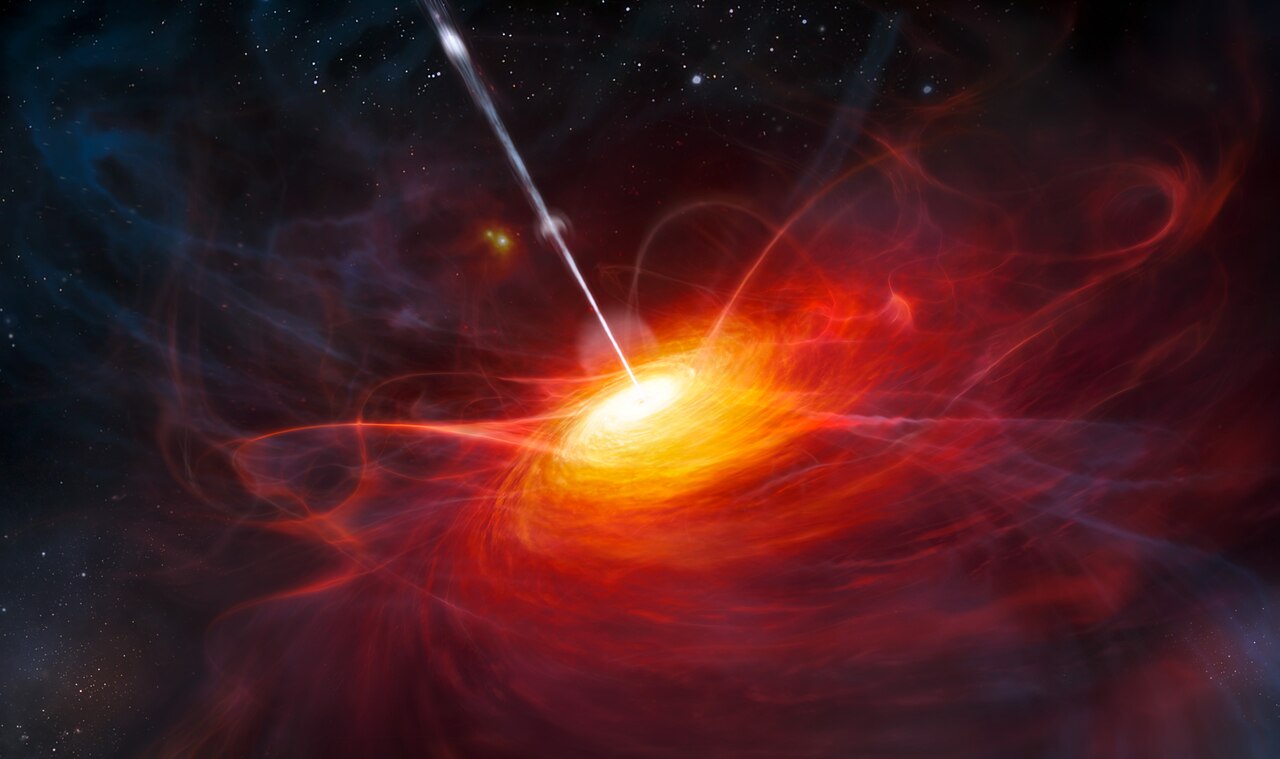
Quasars, or quasi-stellar radio sources, are incredibly luminous objects that have been observed in the distant universe, with some emitting hundreds of times more energy than the entire Milky Way galaxy. First discovered in 1959 by astronomer Caltech's Maarten Schmidt, quasars are believed to be powered by supermassive black holes residing at the centers of galaxies, with masses millions or even billions of times that of the sun. The study of quasars has been instrumental in understanding the early universe, galaxy evolution, and the growth of supermassive black holes. With a vibe score of 8, quasars continue to fascinate astronomers and the public alike, with ongoing research and new discoveries, such as the detection of quasar feedback, which is thought to regulate star formation in galaxies. The most distant quasar observed to date, ULAS J1342+0928, is seen as it was just 690 million years after the Big Bang, providing a unique window into the universe's formative years. As our understanding of quasars evolves, so too does our appreciation for the complex and dynamic nature of the universe, with quasars playing a key role in shaping our understanding of cosmic evolution.
🌌 Introduction to Quasars
Quasars, or quasi-stellar objects, are incredibly luminous astronomical phenomena that have captivated scientists and the public alike. These active galactic nuclei (AGN) are powered by supermassive black holes at the centers of galaxies, with masses ranging from millions to tens of billions of solar masses. The accretion process of gas onto these black holes releases an enormous amount of energy, making quasars among the brightest objects in the universe. Quasars are typically categorized as a subclass of AGN, and their study has significantly advanced our understanding of galaxy evolution and the cosmology of the universe.
🔍 Understanding Active Galactic Nuclei
To comprehend quasars, it's essential to understand the broader context of active galactic nuclei (AGN). AGN are incredibly luminous centers of galaxies that are thought to be powered by supermassive black holes. The emission spectra of AGN can provide valuable insights into the physical processes occurring in these regions. By studying AGN, scientists can gain a deeper understanding of the interplay between the black hole, the surrounding accretion disk, and the host galaxy. This knowledge can also be applied to the study of quasars, which are among the most luminous AGN.
🌠 The Power Source of Quasars
The power source of quasars is a supermassive black hole with a mass ranging from millions to tens of billions of solar masses. The accretion process of gas onto this black hole releases an enormous amount of energy, which is then emitted as electromagnetic radiation. This process is thought to occur in the accretion disk surrounding the black hole, where gas is heated up as it falls towards the center. The study of quasars can provide valuable insights into the physics of black hole accretion and the growth of supermassive black holes in the universe.
📈 Luminosity and Energy Output
The luminosity of quasars is truly enormous, with some quasars having luminosities thousands of times greater than that of a galaxy like the Milky Way. This energy output is a result of the accretion process of gas onto the supermassive black hole. The emission spectra of quasars can provide valuable insights into the physical processes occurring in these regions. By studying the luminosity and spectra of quasars, scientists can gain a deeper understanding of the physics of black hole accretion and the growth of supermassive black holes in the universe.
🔭 Observing Quasars
Observing quasars is a challenging task due to their incredible distances from us. However, by using telescopes and other astronomical instruments, scientists can study the spectra and luminosity of quasars. The Hubble Space Telescope and other space telescopes have played a crucial role in the study of quasars, providing high-resolution images and spectroscopic data. By analyzing this data, scientists can gain a deeper understanding of the physics of quasars and the cosmology of the universe.
📊 Redshift and Cosmological Implications
The redshift of quasars is a result of the expansion of the universe. As light travels through the expanding universe, it becomes shifted towards the red end of the spectrum. By measuring the redshift of quasars, scientists can determine their distances and look-back time. This information can provide valuable insights into the evolution of the universe and the formation of galaxies. The study of quasars has significantly advanced our understanding of cosmology and the large-scale structure of the universe.
🤔 Theories and Models of Quasars
Theories and models of quasars have evolved significantly over the years. The standard model of quasars involves a supermassive black hole surrounded by an accretion disk. However, there are still many uncertainties and controversies in the field, particularly regarding the growth and evolution of supermassive black holes. By studying quasars and their host galaxies, scientists can gain a deeper understanding of the interplay between the black hole and the surrounding galaxy.
🌟 Quasars and Galaxy Evolution
Quasars are thought to have played a crucial role in the evolution of galaxies. The energy output of quasars can heat and ionize the surrounding intergalactic medium, affecting the formation of stars and planets. By studying quasars and their host galaxies, scientists can gain a deeper understanding of the interplay between the black hole and the surrounding galaxy. This knowledge can also be applied to the study of galaxy evolution and the cosmology of the universe.
📚 History of Quasar Discovery
The discovery of quasars dates back to the 1950s, when scientists first detected these incredibly luminous objects. The first quasar was discovered in 1959 by Maarten Schmidt, who recognized that the object was not a star but rather a distant galaxy with a supermassive black hole at its center. Since then, thousands of quasars have been discovered, and their study has significantly advanced our understanding of astronomy and cosmology.
👥 Key Researchers and Their Contributions
Many researchers have made significant contributions to the study of quasars. Maarten Schmidt, who discovered the first quasar, is often credited with revolutionizing the field. Other notable researchers include John Bolton and Cyndy Chen, who have made important contributions to our understanding of quasars and their host galaxies. By studying the work of these researchers, scientists can gain a deeper understanding of the history and development of quasar research.
🔍 Controversies and Debates in Quasar Research
Despite the significant progress made in the study of quasars, there are still many controversies and debates in the field. One of the main areas of controversy is the growth and evolution of supermassive black holes. Scientists are still unsure about the mechanisms that drive the growth of these black holes, and there is ongoing research to better understand this process. By studying quasars and their host galaxies, scientists can gain a deeper understanding of the interplay between the black hole and the surrounding galaxy.
🚀 Future Directions in Quasar Studies
The study of quasars is an active area of research, with many scientists working to better understand these incredibly luminous objects. Future missions, such as the James Webb Space Telescope and the Square Kilometre Array, will provide new insights into the physics of quasars and the cosmology of the universe. By continuing to study quasars, scientists can gain a deeper understanding of the universe and its many mysteries.
Key Facts
- Year
- 1959
- Origin
- Maarten Schmidt's discovery of the first quasar, 3C 273
- Category
- Astronomy
- Type
- Astronomical Object
Frequently Asked Questions
What is a quasar?
A quasar, or quasi-stellar object, is an incredibly luminous active galactic nucleus (AGN) that is thought to be powered by a supermassive black hole at the center of a galaxy. The accretion process of gas onto this black hole releases an enormous amount of energy, making quasars among the brightest objects in the universe.
How are quasars different from other AGN?
Quasars are among the most luminous AGN, with luminosities that can be thousands of times greater than that of a galaxy like the Milky Way. They are also typically characterized by their blue continuum emission and broad emission lines.
What can we learn from studying quasars?
How are quasars observed?
Quasars are observed using telescopes and other astronomical instruments. The Hubble Space Telescope and other space telescopes have played a crucial role in the study of quasars, providing high-resolution images and spectroscopic data.
What is the significance of quasar redshift?
What are some of the current challenges in quasar research?
Despite the significant progress made in the study of quasars, there are still many controversies and debates in the field. One of the main areas of controversy is the growth and evolution of supermassive black holes. Scientists are still unsure about the mechanisms that drive the growth of these black holes, and there is ongoing research to better understand this process.
What can we expect from future quasar research?
The study of quasars is an active area of research, with many scientists working to better understand these incredibly luminous objects. Future missions, such as the James Webb Space Telescope and the Square Kilometre Array, will provide new insights into the physics of quasars and the cosmology of the universe.