
Contents
- 🌍 Introduction to African Languages
- 📚 Language Families of Africa
- 🗺️ Geographic Distribution of African Languages
- 🌟 Niger–Congo Language Family
- 🌄 Afroasiatic Language Family
- 🌅 Other Language Families in Africa
- 📊 Linguistic Diversity in Africa
- 🌈 Language and Culture in Africa
- 📚 Language and Education in Africa
- 🌐 Language and Globalization in Africa
- 🤝 Language Preservation and Promotion in Africa
- Frequently Asked Questions
- Related Topics
Overview
African languages comprise a staggering array of over 2,000 languages, accounting for approximately 30% of the world's total languages. With a vibe score of 8, they reflect the continent's rich cultural diversity, from the Afro-Asiatic languages spoken in North Africa to the Niger-Congo languages spoken in sub-Saharan Africa. The Bantu languages, with over 500 languages, are a significant subgroup within the Niger-Congo family. Despite their importance, many African languages face the threat of extinction due to urbanization, globalization, and the dominance of European languages. According to a UNESCO report, approximately 43% of African languages are at risk of disappearing. The African language with the highest number of native speakers is Arabic, with over 150 million speakers, followed by Hausa, with over 50 million speakers. As the continent continues to urbanize and globalize, the preservation and promotion of African languages have become increasingly important, with many countries implementing language policies to support linguistic diversity.
🌍 Introduction to African Languages
African languages are a vital part of the continent's cultural heritage, with over 1,250 languages spoken across the region. The Niger-Congo language family is the largest, with over 500 languages spoken in West, Central, Southeast, and Southern Africa. The Afroasiatic language family is also widely spoken, with languages such as Arabic, Amharic, and Swahili being used as lingua francas in many countries. The linguistic diversity of Africa is a reflection of the continent's rich cultural history, with many languages having been influenced by colonialism and slavery. For example, the Yoruba language of Nigeria has been influenced by English and Portuguese.
📚 Language Families of Africa
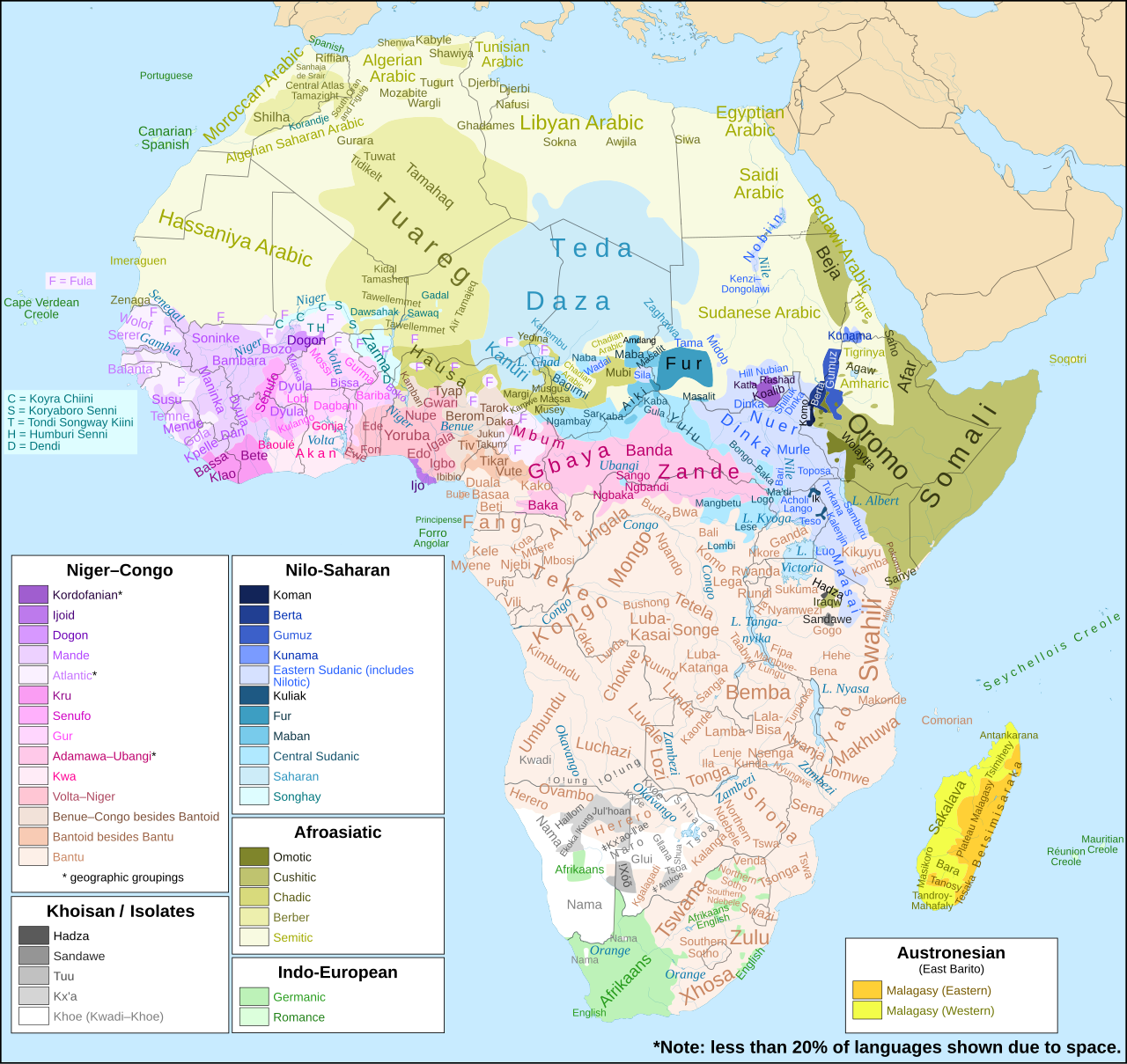
The languages of Africa belong to several distinct language families, including Niger-Congo, Afroasiatic, Saharan, Nilotic, and Central Sudanic. Each language family has its own unique characteristics and history, with some languages having been spoken for thousands of years. The Khoe-Kwadi language family, for example, is spoken mostly in Namibia and Botswana, and is known for its complex grammar and phonology. The Austronesian language family is spoken in Madagascar and parts of the Comoros, and is known for its distinctive sound system.
🗺️ Geographic Distribution of African Languages
The geographic distribution of African languages is complex and varied, with many languages being spoken across national borders. The Sahel region, for example, is home to many languages, including Hausa, Fula, and Kanuri. The Horn of Africa is home to many Afroasiatic languages, including Amharic, Tigrinya, and Somali. The Southern Africa region is home to many Niger-Congo languages, including Zulu, Xhosa, and Sotho.
🌟 Niger–Congo Language Family
The Niger-Congo language family is the largest language family in Africa, with over 500 languages spoken across the continent. The family includes languages such as Swahili, Yoruba, and Shona, which are all widely spoken and have been influenced by colonialism and slavery. The Bantu language branch is a subgroup of the Niger-Congo language family, and includes languages such as Zulu, Xhosa, and Sotho. The Atlantic-Congo language branch is another subgroup of the Niger-Congo language family, and includes languages such as Fula and Wolof.
🌄 Afroasiatic Language Family
The Afroasiatic language family is widely spoken in Africa, with languages such as Arabic, Amharic, and Swahili being used as lingua francas in many countries. The family includes languages such as Hebrew and Ge'ez, which are spoken in Israel and Ethiopia, respectively. The Semitic language branch is a subgroup of the Afroasiatic language family, and includes languages such as Arabic and Hebrew. The Berber language branch is another subgroup of the Afroasiatic language family, and includes languages such as Tamazight and Rifian.
🌅 Other Language Families in Africa
In addition to the Niger-Congo and Afroasiatic language families, there are several other language families spoken in Africa. The Saharan language family is spoken in the Sahara Desert region, and includes languages such as Kanuri and Tebu. The Nilotic language family is spoken in the Nilotic region, and includes languages such as Luo and Maasai. The Central Sudanic language family is spoken in the Central Africa region, and includes languages such as Mangbetu and Ngbandi.
📊 Linguistic Diversity in Africa
Africa is home to an incredible amount of linguistic diversity, with over 1,250 languages spoken across the continent. The Nigeria alone has over 500 languages, making it one of the most linguistically diverse countries in the world. The Democratic Republic of the Congo is another country with a high level of linguistic diversity, with over 450 languages spoken. The South Africa is also home to many languages, including Afrikaans, English, and IsiZulu.
🌈 Language and Culture in Africa
Language and culture are closely tied in Africa, with many languages being an integral part of a community's cultural heritage. The Yoruba language, for example, is an important part of Yoruba culture, with many Yoruba people speaking the language as their mother tongue. The Swahili language is another example, with many people in Tanzania and Kenya speaking the language as a lingua franca. The Amharic language is also an important part of Ethiopian culture, with many people in Ethiopia speaking the language as their mother tongue.
📚 Language and Education in Africa
Language and education are also closely tied in Africa, with many languages being used as languages of instruction in schools. The English language is widely used as a language of instruction in many African countries, including South Africa, Nigeria, and Kenya. The French language is also widely used as a language of instruction in many African countries, including Democratic Republic of the Congo, Cameroon, and Senegal. The Portuguese language is also used as a language of instruction in some African countries, including Angola and Mozambique.
🌐 Language and Globalization in Africa
The impact of globalization on African languages is a complex issue, with some languages being more affected than others. The English language is widely used as a global language, and has had a significant impact on many African languages. The French language is also widely used as a global language, and has had a significant impact on many African languages. The Arabic language is also widely used as a global language, and has had a significant impact on many African languages.
🤝 Language Preservation and Promotion in Africa
The preservation and promotion of African languages is an important issue, with many languages being at risk of extinction. The United Nations Educational, Scientific and Cultural Organization (UNESCO) has recognized the importance of preserving and promoting African languages, and has launched several initiatives to support language preservation and promotion. The African Union has also recognized the importance of preserving and promoting African languages, and has launched several initiatives to support language preservation and promotion.
Key Facts
- Year
- 2022
- Origin
- Africa
- Category
- Linguistics
- Type
- Language Family
Frequently Asked Questions
What is the most widely spoken language in Africa?
The most widely spoken language in Africa is Arabic, with over 150 million speakers. The Hausa language is also widely spoken, with over 50 million speakers. The Swahili language is also widely spoken, with over 40 million speakers.
What is the largest language family in Africa?
The largest language family in Africa is the Niger-Congo language family, with over 500 languages spoken across the continent. The family includes languages such as Swahili, Yoruba, and Shona.
What is the impact of globalization on African languages?
The impact of globalization on African languages is a complex issue, with some languages being more affected than others. The English language is widely used as a global language, and has had a significant impact on many African languages. The French language is also widely used as a global language, and has had a significant impact on many African languages.
What is being done to preserve and promote African languages?
The United Nations Educational, Scientific and Cultural Organization (UNESCO) has recognized the importance of preserving and promoting African languages, and has launched several initiatives to support language preservation and promotion. The African Union has also recognized the importance of preserving and promoting African languages, and has launched several initiatives to support language preservation and promotion.
What is the role of language in African culture?
Language and culture are closely tied in Africa, with many languages being an integral part of a community's cultural heritage. The Yoruba language, for example, is an important part of Yoruba culture, with many Yoruba people speaking the language as their mother tongue. The Swahili language is another example, with many people in Tanzania and Kenya speaking the language as a lingua franca.
What is the future of African languages?
The future of African languages is uncertain, with many languages being at risk of extinction. However, there are also many initiatives being launched to support language preservation and promotion, and to recognize the importance of African languages in African culture and identity. The African Union has recognized the importance of preserving and promoting African languages, and has launched several initiatives to support language preservation and promotion.
What is the relationship between language and education in Africa?
Language and education are closely tied in Africa, with many languages being used as languages of instruction in schools. The English language is widely used as a language of instruction in many African countries, including South Africa, Nigeria, and Kenya. The French language is also widely used as a language of instruction in many African countries, including Democratic Republic of the Congo, Cameroon, and Senegal.