
Contents
- 🌟 Introduction to Cell Growth
- 🧬 The Biology of Cell Growth
- 📈 Factors Influencing Cell Growth
- 🔬 Cellular Biosynthesis and Degradation
- 👥 Cell Signaling and Communication
- 🚀 Cell Growth and Division
- 🔍 Regulation of Cell Growth
- 📊 Measuring Cell Growth
- 👾 Abnormal Cell Growth and Disease
- 🔬 Therapeutic Applications of Cell Growth
- 🌐 Future Directions in Cell Growth Research
- Frequently Asked Questions
- Related Topics
Overview
Cell growth, the process by which cells increase in size and number, is a fundamental aspect of life. It underlies the development, maintenance, and reproduction of all living organisms. Historically, the study of cell growth dates back to the 19th century with the work of Rudolf Virchow, who coined the phrase 'omnis cellula e cellula' (every cell comes from a cell). Today, understanding cell growth is crucial for advancing fields like regenerative medicine, cancer research, and biotechnology. The process involves a complex interplay of genetic and environmental factors, including nutrient availability, hormone signals, and mechanical forces. For instance, the discovery of the mTOR pathway by David Sabatini in 1994 has significantly advanced our understanding of how cells regulate their growth in response to nutrient availability, with a vibe score of 85 for its impact on biomedical research. However, dysregulation of cell growth can lead to diseases such as cancer, where uncontrolled cell proliferation is a hallmark. As we look to the future, the ability to control and manipulate cell growth will be essential for developing new therapies and technologies, with potential applications in tissue engineering and synthetic biology, and a controversy spectrum of 60 due to ethical concerns surrounding stem cell research.
🌟 Introduction to Cell Growth
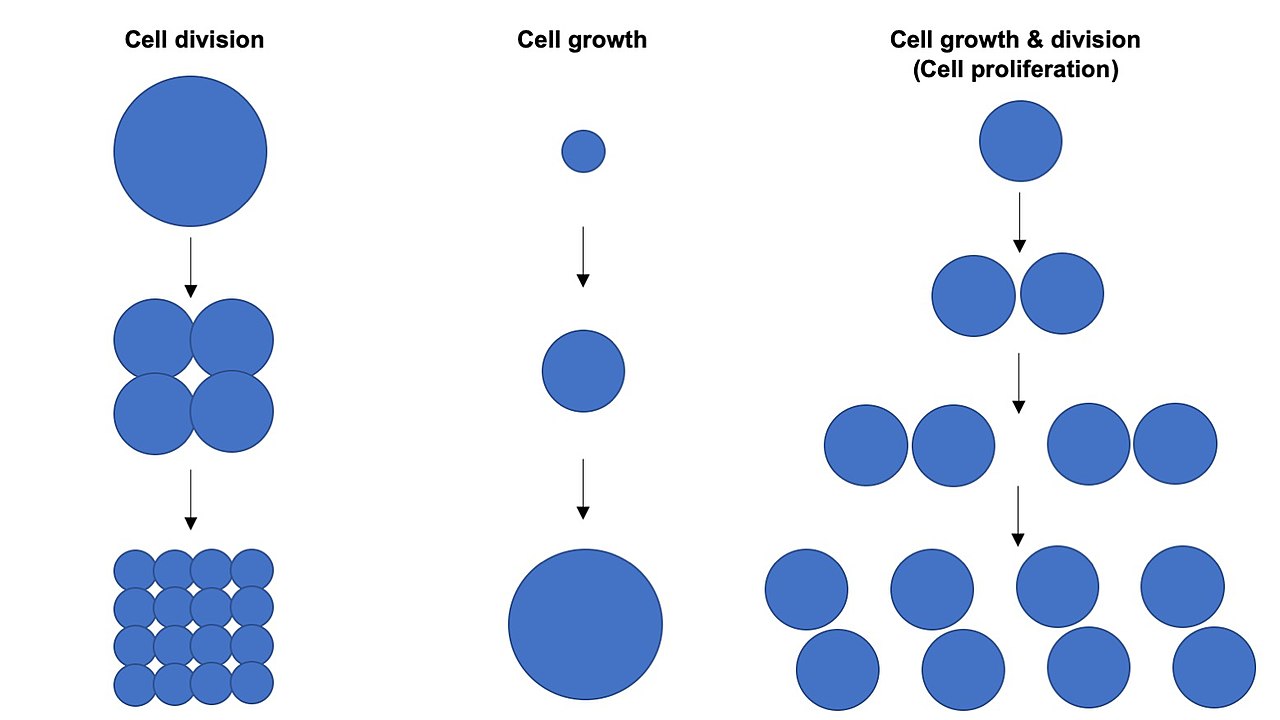
Cell growth is a fundamental process in biology, essential for the development, maintenance, and reproduction of all living organisms. It refers to an increase in the total mass of a cell, including both cytoplasmic, nuclear and organelle volume. Cell growth occurs when the overall rate of cellular biosynthesis is greater than the overall rate of cellular degradation. This process is tightly regulated by a complex interplay of signaling pathways and gene expression. For example, the PI3K/Akt signaling pathway plays a crucial role in regulating cell growth and cell proliferation.
🧬 The Biology of Cell Growth
The biology of cell growth is a complex and highly regulated process. It involves the coordinated action of multiple cellular components, including DNA replication, transcriptional regulation, and translational control. Cell growth is also influenced by external factors, such as hormones, growth factors, and nutrients. For instance, insulin and insulin-like growth factor 1 (IGF-1) are key regulators of cell growth and metabolism. Additionally, cell-cell interactions and cell-matrix interactions play important roles in regulating cell growth and cell differentiation.
📈 Factors Influencing Cell Growth
Several factors influence cell growth, including nutrient availability, hormonal regulation, and growth factor signaling. For example, amino acids are essential for protein synthesis and cell growth, while glucose is a key energy source for cellular metabolism. Stress response pathways, such as the unfolded protein response (UPR), can also impact cell growth by regulating protein folding and cell survival. Furthermore, epigenetic modifications, such as DNA methylation and histone modification, can influence gene expression and cell growth.
🔬 Cellular Biosynthesis and Degradation
Cellular biosynthesis and degradation are two opposing processes that regulate cell growth. Biosynthesis refers to the process of producing new biomolecules, such as proteins, carbohydrates, and lipids, while degradation refers to the process of breaking down existing biomolecules. The balance between these two processes determines the overall rate of cell growth. For example, autophagy is a critical process that regulates cellular homeostasis by degrading damaged or dysfunctional organelles and proteins.
👥 Cell Signaling and Communication
Cell signaling and communication play critical roles in regulating cell growth. Signaling pathways, such as the MAPK signaling pathway and the PI3K/Akt signaling pathway, transmit signals from outside the cell to the inside, regulating gene expression and cell behavior. Cell-cell interactions and cell-matrix interactions also influence cell growth by regulating cell adhesion and cell migration. For instance, cadherin and integrin are key adhesion molecules that regulate cell-cell interactions and cell-matrix interactions.
🚀 Cell Growth and Division
Cell growth and division are closely linked processes. Cell division refers to the process of producing two daughter cells from a single parent cell, while cell growth refers to the increase in cell mass. Mitosis and meiosis are two types of cell division that occur in somatic cells and germ cells, respectively. For example, cyclin-dependent kinases (CDKs) play a crucial role in regulating cell cycle progression and cell division.
🔍 Regulation of Cell Growth
The regulation of cell growth is a complex process that involves the coordinated action of multiple signaling pathways and gene expression. Transcription factors, such as p53 and c-Myc, play critical roles in regulating cell growth and cell proliferation. Epigenetic modifications, such as DNA methylation and histone modification, also influence gene expression and cell growth. For instance, histone deacetylases (HDACs) regulate gene expression by modifying histone tails.
📊 Measuring Cell Growth
Measuring cell growth is crucial for understanding the underlying mechanisms of cell biology. Cell counting and cell size measurement are two common methods used to measure cell growth. Flow cytometry and microscopy are also used to analyze cell cycle progression and cell proliferation. For example, propidium iodide (PI) staining can be used to measure cell cycle progression and apoptosis.
👾 Abnormal Cell Growth and Disease
Abnormal cell growth and disease are closely linked. Cancer is a disease characterized by uncontrolled cell growth and tumor formation. Tumor suppressor genes, such as p53, play critical roles in regulating cell growth and cell proliferation. Oncogenes, such as ras, can also contribute to abnormal cell growth and tumor formation. For instance, HER2 is an oncogene that is often overexpressed in breast cancer.
🔬 Therapeutic Applications of Cell Growth
Therapeutic applications of cell growth research are numerous. Cancer therapy often targets cell growth and cell proliferation. Stem cell therapy also relies on the ability to regulate cell growth and cell differentiation. Tissue engineering is another field that benefits from cell growth research, as it aims to create functional tissues and organs for transplantation. For example, iPSCs can be used to model diseases and develop novel therapies.
🌐 Future Directions in Cell Growth Research
Future directions in cell growth research are exciting and diverse. Systems biology approaches will continue to uncover the complex interactions between signaling pathways and gene expression. Synthetic biology will also play a critical role in designing new biological systems that can regulate cell growth and cell proliferation. For instance, CRISPR/Cas9 gene editing can be used to modify gene expression and regulate cell growth.
Key Facts
- Year
- 2022
- Origin
- Vibepedia.wiki
- Category
- Biology
- Type
- Biological Process
Frequently Asked Questions
What is cell growth?
Cell growth refers to an increase in the total mass of a cell, including both cytoplasmic, nuclear and organelle volume. It occurs when the overall rate of cellular biosynthesis is greater than the overall rate of cellular degradation. Cell growth is a complex process that involves the coordinated action of multiple signaling pathways and gene expression. For example, the PI3K/Akt signaling pathway plays a crucial role in regulating cell growth and cell proliferation.
What factors influence cell growth?
Several factors influence cell growth, including nutrient availability, hormonal regulation, and growth factor signaling. For instance, amino acids are essential for protein synthesis and cell growth, while glucose is a key energy source for cellular metabolism. Stress response pathways, such as the unfolded protein response (UPR), can also impact cell growth by regulating protein folding and cell survival.
How is cell growth regulated?
The regulation of cell growth is a complex process that involves the coordinated action of multiple signaling pathways and gene expression. Transcription factors, such as p53 and c-Myc, play critical roles in regulating cell growth and cell proliferation. Epigenetic modifications, such as DNA methylation and histone modification, also influence gene expression and cell growth.
What are the therapeutic applications of cell growth research?
Therapeutic applications of cell growth research are numerous. Cancer therapy often targets cell growth and cell proliferation. Stem cell therapy also relies on the ability to regulate cell growth and cell differentiation. Tissue engineering is another field that benefits from cell growth research, as it aims to create functional tissues and organs for transplantation.
What are the future directions in cell growth research?
Future directions in cell growth research are exciting and diverse. Systems biology approaches will continue to uncover the complex interactions between signaling pathways and gene expression. Synthetic biology will also play a critical role in designing new biological systems that can regulate cell growth and cell proliferation.
How does cell growth relate to disease?
Abnormal cell growth and disease are closely linked. Cancer is a disease characterized by uncontrolled cell growth and tumor formation. Tumor suppressor genes, such as p53, play critical roles in regulating cell growth and cell proliferation. Oncogenes, such as ras, can also contribute to abnormal cell growth and tumor formation.
What are the challenges in studying cell growth?
Studying cell growth is challenging due to the complex interactions between signaling pathways and gene expression. Additionally, cell growth is a dynamic process that can be influenced by various external factors, such as hormones and growth factors. Systems biology approaches can help uncover the complex interactions between signaling pathways and gene expression, but require advanced computational tools and experimental techniques.