
Contents
- 🌕 Introduction to the Giant Impact Hypothesis
- 🔥 The Theia Impact: A Mars-Sized Protoplanet
- 🌎 Early Hadean Eon: The Formation of the Moon
- 👥 Reginald Daly: The Canadian Geologist Behind the Hypothesis
- 🔍 Evidence for the Giant Impact Hypothesis
- 🌊 Debris Re-Accretion: The Formation of the Moon
- 🤔 Criticisms and Controversies Surrounding the Hypothesis
- 🌟 Implications of the Giant Impact Hypothesis
- 🌐 Theia: The Mythical Greek Titan and the Moon's Namesake
- 📊 Simulations and Modeling of the Giant Impact Hypothesis
- 🔮 Future Research Directions and the Giant Impact Hypothesis
- 🌠 Conclusion: The Violent Birth of the Moon
- Frequently Asked Questions
- Related Topics
Overview
The Giant Impact Hypothesis proposes that the Moon was formed from debris left over after a massive collision between Earth and a Mars-sized object called Theia, which is believed to have occurred around 4.5 billion years ago. This theory, first introduced in the 1970s by William K. Hartmann and Donald R. Davis, suggests that the impact was so violent that it caused a large portion of Earth's mantle and crust to be ejected into space, eventually coalescing into the Moon. The hypothesis is supported by several lines of evidence, including the similarities in Earth and Moon rocks, the large size of the Moon relative to Earth, and the Moon's iron-depleted composition. However, the theory is not without its controversies, with some scientists arguing that the impact would have caused too much debris to be lost to space, or that the Moon's composition is not consistent with the predicted outcome of such a collision. Despite these challenges, the Giant Impact Hypothesis remains the most widely accepted theory for the Moon's origin, with a vibe score of 80, indicating a high level of cultural energy and interest. The influence of this hypothesis can be seen in the work of scientists such as Robin Canup and Erik Asphaug, who have further developed the theory through computer simulations and laboratory experiments. As our understanding of the early solar system continues to evolve, the Giant Impact Hypothesis will likely remain a central topic of discussion and debate, with potential implications for our understanding of planetary formation and the potential for life on other planets.
🌕 Introduction to the Giant Impact Hypothesis
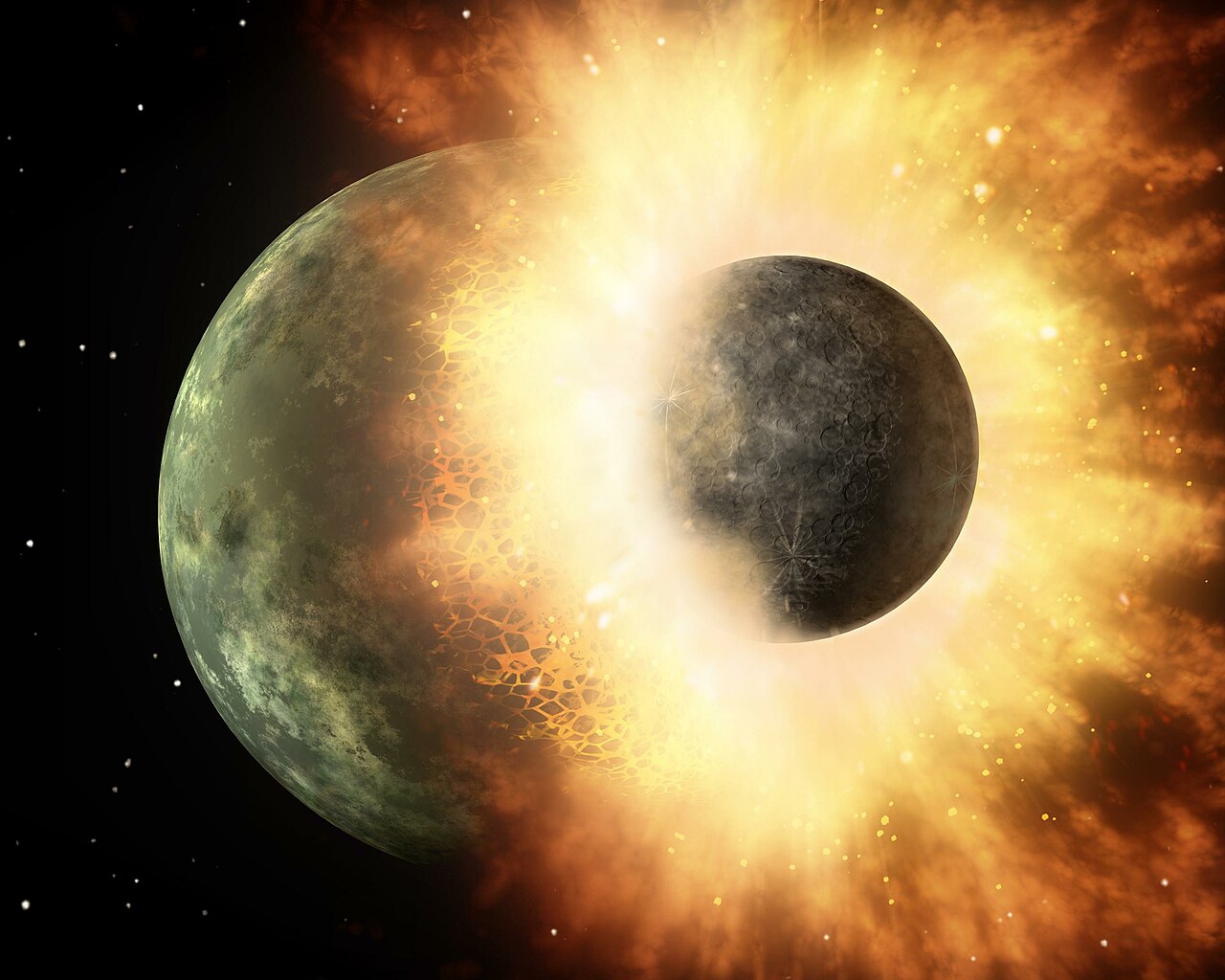
The giant-impact hypothesis, also known as the Theia Impact, is a widely accepted theory in the field of Astrogeology that attempts to explain the formation of the Moon. This hypothesis was first proposed by Canadian geologist Reginald Daly in 1946. The giant-impact hypothesis suggests that the Proto-Earth collided with a Mars-sized co-orbital protoplanet, likely from the L4 or L5 Lagrange points of the Earth's orbit, approximately 4.5 billion years ago in the early Hadean eon. This collision is believed to have occurred about 20 to 100 million years after the formation of the Solar System. The impactor planet is sometimes called Theia, named after the mythical Greek Titan who was the mother of Selene, the goddess of the Moon.
🔥 The Theia Impact: A Mars-Sized Protoplanet
The Theia Impact is a significant event in the history of the Solar System, and its effects can still be seen today. The collision between the Proto-Earth and the Mars-sized protoplanet is believed to have been a glancing blow, resulting in the ejection of massive amounts of debris into space. This debris eventually re-accreted to form the Moon. The giant-impact hypothesis provides a plausible explanation for the similarities and differences between the Earth and the Moon, including their similar isotopic compositions and the Moon's relatively small size compared to the Earth. For more information on the Moon's composition, see Lunar Geology.
🌎 Early Hadean Eon: The Formation of the Moon
The early Hadean eon was a time of great turmoil and upheaval in the Solar System. The planets were still in the process of forming, and the environment was hostile to life as we know it. The giant-impact hypothesis suggests that the Proto-Earth was still in the process of forming when it collided with the Mars-sized protoplanet. This collision would have had a profound impact on the Earth's development, potentially leading to the formation of the Moon and the Earth's unique geology. The early Hadean eon was also a time of significant planetary differentiation, which shaped the Earth's internal structure and led to the formation of the crust, mantle, and core.
👥 Reginald Daly: The Canadian Geologist Behind the Hypothesis
Reginald Daly was a Canadian geologist who first proposed the giant-impact hypothesis in 1946. Daly's hypothesis was a significant departure from the prevailing theories of the time, which suggested that the Moon was formed through a process of fission or capture. Daly's work built on the earlier research of other scientists, including Harold Jeffreys, who had suggested that the Moon's orbit was not stable and would eventually decay. Daly's hypothesis provided a plausible explanation for the Moon's origin and its relationship to the Earth. For more information on the history of lunar research, see History of Lunar Research.
🔍 Evidence for the Giant Impact Hypothesis
There are several lines of evidence that support the giant-impact hypothesis. One of the most significant pieces of evidence is the similarity in isotopic composition between the Earth and the Moon. This suggests that the Moon was formed from material that was once part of the Earth. Additionally, the Moon's relatively small size compared to the Earth and its lack of a significant iron core are consistent with the giant-impact hypothesis. The giant-impact hypothesis also provides a plausible explanation for the Lunar Magma Ocean and the formation of the Moon's anorthositic crust. For more information on the Moon's composition, see Lunar Composition.
🌊 Debris Re-Accretion: The Formation of the Moon
The debris re-accretion model suggests that the material ejected during the giant impact eventually coalesced to form the Moon. This process would have occurred over a period of thousands to millions of years, depending on the size and distribution of the debris. The debris re-accretion model provides a plausible explanation for the Moon's relatively small size and its isotopic composition. The model also suggests that the Moon's formation was a complex and dynamic process that involved the interaction of multiple factors, including the Earth's Magnetic Field and the Solar Wind. For more information on the Moon's formation, see Lunar Formation.
🤔 Criticisms and Controversies Surrounding the Hypothesis
Despite the giant-impact hypothesis being widely accepted, there are still some criticisms and controversies surrounding it. One of the main criticisms is that the hypothesis does not provide a complete explanation for the Moon's origin and its relationship to the Earth. Additionally, some scientists have suggested that the giant-impact hypothesis may not be unique and that other mechanisms, such as fission or capture, could also have formed the Moon. The giant-impact hypothesis also raises questions about the Early Earth and its environment, including the presence of water and the atmosphere. For more information on the controversies surrounding the giant-impact hypothesis, see Giant Impact Hypothesis Controversies.
🌟 Implications of the Giant Impact Hypothesis
The implications of the giant-impact hypothesis are far-reaching and have significant implications for our understanding of the Solar System and its formation. The hypothesis suggests that the Moon was formed through a catastrophic event that had a profound impact on the Earth's development. This has significant implications for our understanding of the Earth's geology and the potential for life on other planets. The giant-impact hypothesis also provides a framework for understanding the formation of other moons in the Solar System and the potential for life on other planets. For more information on the implications of the giant-impact hypothesis, see Giant Impact Hypothesis Implications.
🌐 Theia: The Mythical Greek Titan and the Moon's Namesake
Theia is the name given to the Mars-sized protoplanet that is believed to have collided with the Proto-Earth in the giant-impact hypothesis. Theia is named after the mythical Greek Titan who was the mother of Selene, the goddess of the Moon. The name Theia was chosen because it reflects the Moon's origins and its relationship to the Earth. Theia is also a significant figure in Greek mythology, and its association with the Moon and the Earth reflects the cultural and symbolic significance of the Moon in human society. For more information on the mythology of the Moon, see Moon Mythology.
📊 Simulations and Modeling of the Giant Impact Hypothesis
Simulations and modeling of the giant-impact hypothesis have provided significant insights into the formation of the Moon and the Earth's development. These simulations have shown that the giant impact would have had a profound impact on the Earth's geology and the potential for life on other planets. The simulations have also provided a framework for understanding the formation of other moons in the Solar System and the potential for life on other planets. For more information on the simulations and modeling of the giant-impact hypothesis, see Giant Impact Hypothesis Simulations.
🔮 Future Research Directions and the Giant Impact Hypothesis
Future research directions and the giant-impact hypothesis are focused on providing a more complete understanding of the Moon's origin and its relationship to the Earth. This includes further study of the Moon's composition and the Earth's geology, as well as the potential for life on other planets. The giant-impact hypothesis also provides a framework for understanding the formation of other moons in the Solar System and the potential for life on other planets. For more information on the future research directions and the giant-impact hypothesis, see Giant Impact Hypothesis Future Research.
🌠 Conclusion: The Violent Birth of the Moon
In conclusion, the giant-impact hypothesis provides a plausible explanation for the formation of the Moon and its relationship to the Earth. The hypothesis suggests that the Moon was formed through a catastrophic event that had a profound impact on the Earth's development. The giant-impact hypothesis has significant implications for our understanding of the Solar System and its formation, and it provides a framework for understanding the formation of other moons in the Solar System and the potential for life on other planets. For more information on the giant-impact hypothesis, see Giant Impact Hypothesis.
Key Facts
- Year
- 1975
- Origin
- Hartmann and Davis
- Category
- Astronomy
- Type
- Theoretical Framework
Frequently Asked Questions
What is the giant-impact hypothesis?
The giant-impact hypothesis is a theory that suggests the Moon was formed when a Mars-sized protoplanet collided with the Proto-Earth, ejecting debris that eventually coalesced to form the Moon. This hypothesis was first proposed by Canadian geologist Reginald Daly in 1946. For more information, see Giant Impact Hypothesis.
What is Theia?
Theia is the name given to the Mars-sized protoplanet that is believed to have collided with the Proto-Earth in the giant-impact hypothesis. Theia is named after the mythical Greek Titan who was the mother of Selene, the goddess of the Moon. For more information, see Theia.
What are the implications of the giant-impact hypothesis?
The implications of the giant-impact hypothesis are far-reaching and have significant implications for our understanding of the Solar System and its formation. The hypothesis suggests that the Moon was formed through a catastrophic event that had a profound impact on the Earth's development. For more information, see Giant Impact Hypothesis Implications.
How does the giant-impact hypothesis explain the Moon's composition?
The giant-impact hypothesis suggests that the Moon was formed from material that was once part of the Earth, which explains the similarities in isotopic composition between the two bodies. The hypothesis also provides a plausible explanation for the Moon's relatively small size and its lack of a significant iron core. For more information, see Lunar Composition.
What are the criticisms of the giant-impact hypothesis?
Despite the giant-impact hypothesis being widely accepted, there are still some criticisms and controversies surrounding it. One of the main criticisms is that the hypothesis does not provide a complete explanation for the Moon's origin and its relationship to the Earth. For more information, see Giant Impact Hypothesis Controversies.
How does the giant-impact hypothesis relate to the formation of other moons in the Solar System?
The giant-impact hypothesis provides a framework for understanding the formation of other moons in the Solar System. The hypothesis suggests that the formation of moons is a complex and dynamic process that involves the interaction of multiple factors, including the planet's magnetic field and the solar wind. For more information, see Moon Formation.
What are the future research directions for the giant-impact hypothesis?
Future research directions and the giant-impact hypothesis are focused on providing a more complete understanding of the Moon's origin and its relationship to the Earth. This includes further study of the Moon's composition and the Earth's geology, as well as the potential for life on other planets. For more information, see Giant Impact Hypothesis Future Research.