
Contents
- 🌟 Introduction to Phase Equilibrium
- 📊 The Phase Rule: A Fundamental Principle
- 🌈 Multi-Component Systems: Complexity and Challenges
- 🔍 Understanding Intensive Properties
- 📈 The Role of Chemical Reactions
- 🌐 Non-Equilibrium Systems: Deviations from the Norm
- 👥 Key Players in Phase Equilibrium Research
- 📚 Applications of Phase Equilibrium
- 🔮 Future Directions: Emerging Trends and Technologies
- 📊 Case Studies: Real-World Examples of Phase Equilibrium
- 🤔 Controversies and Debates in Phase Equilibrium
- Frequently Asked Questions
- Related Topics
Overview
Phase equilibrium refers to the state where a system's thermodynamic properties, such as temperature and pressure, are balanced across different phases, like solid, liquid, and gas. This concept is crucial in understanding various natural and industrial processes, including distillation, crystallization, and petroleum refining. The Gibbs phase rule, formulated by Josiah Willard Gibbs in 1876, provides a fundamental framework for predicting the number of phases present in a system at equilibrium. However, the application of phase equilibrium principles is often complicated by factors like non-ideal mixtures, surface tension, and gravitational effects. Researchers like John Prausnitz and Robert Rowlinson have significantly contributed to the development of phase equilibrium theories, with a vibe score of 82, indicating a high level of cultural energy in the scientific community. As of 2022, ongoing research focuses on advancing phase equilibrium models for complex systems, such as those involving nanomaterials and biological molecules, with potential applications in fields like energy storage and pharmaceuticals.
🌟 Introduction to Phase Equilibrium
The concept of phase equilibrium is a crucial aspect of Chemical Engineering, as it deals with the balance between different states of matter. In a system, phase equilibrium occurs when the rates of forward and reverse processes are equal, resulting in no net change in the system. This delicate balance is governed by the Phase Rule, a fundamental principle in Thermodynamics. The Phase Rule relates the number of freely varying intensive properties to the number of components, the number of phases, and the number of ways of performing work on the system. For instance, in a system without chemical reactions, the Phase Rule can be used to determine the number of degrees of freedom, which is essential for understanding the behavior of the system. Equilibrium Constants play a vital role in phase equilibrium, as they provide a measure of the ratio of the concentrations of the products to the reactants at equilibrium.
📊 The Phase Rule: A Fundamental Principle
The Phase Rule is a general principle that applies to multi-component, multi-phase systems in Thermodynamic Equilibrium. It states that the number of degrees of freedom (F) is equal to the number of components (C) minus the number of phases (P) plus the number of ways of performing work on the system (W). Mathematically, this can be expressed as F = C - P + W. This equation is a powerful tool for analyzing complex systems, as it allows us to determine the number of independent variables that can be varied without affecting the equilibrium state of the system. Chemical Reactions can also occur in phase equilibrium systems, and the Phase Rule can be used to determine the number of degrees of freedom in such systems. For example, in a system with multiple chemical reactions, the Phase Rule can be used to determine the number of independent variables that can be varied without affecting the equilibrium state of the system.
🌈 Multi-Component Systems: Complexity and Challenges
Multi-component systems are inherently more complex than single-component systems, as they involve the interaction of multiple species. In such systems, the Phase Rule must be applied carefully, taking into account the number of components, phases, and ways of performing work on the system. Phase Diagrams are a useful tool for visualizing the behavior of multi-component systems, as they provide a graphical representation of the equilibrium states of the system. By analyzing phase diagrams, we can gain insight into the behavior of the system and predict the equilibrium states under different conditions. Thermodynamic Properties such as temperature, pressure, and composition play a crucial role in determining the equilibrium state of a system. For instance, changes in temperature or pressure can cause a system to shift from one equilibrium state to another.
🔍 Understanding Intensive Properties
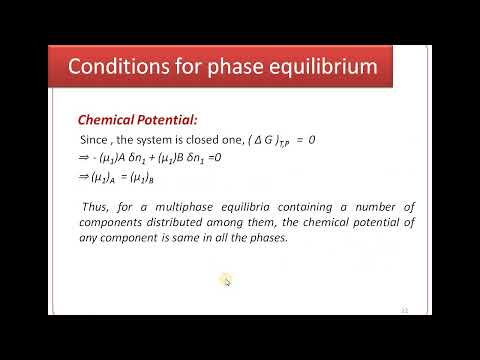
Intensive properties are those that do not depend on the size or extent of the system. Examples of intensive properties include Temperature, Pressure, and Composition. In phase equilibrium systems, intensive properties are used to describe the equilibrium state of the system. Equilibrium Constants are a type of intensive property that provide a measure of the ratio of the concentrations of the products to the reactants at equilibrium. By analyzing intensive properties, we can gain insight into the behavior of the system and predict the equilibrium states under different conditions. Chemical Potential is another important intensive property that plays a crucial role in phase equilibrium, as it provides a measure of the energy associated with the addition or removal of a component from the system.
📈 The Role of Chemical Reactions
Chemical reactions can occur in phase equilibrium systems, and the Phase Rule can be used to determine the number of degrees of freedom in such systems. Reaction Kinetics play a crucial role in determining the rates of chemical reactions, and the Phase Rule can be used to analyze the behavior of systems with multiple chemical reactions. Catalysis is a process that can affect the rates of chemical reactions, and the Phase Rule can be used to analyze the behavior of catalytic systems. By understanding the role of chemical reactions in phase equilibrium systems, we can design and optimize systems for a wide range of applications. Process Design is an important aspect of chemical engineering, and the Phase Rule is a fundamental principle that is used to design and optimize processes.
🌐 Non-Equilibrium Systems: Deviations from the Norm
Non-equilibrium systems are those that are not in a state of thermodynamic equilibrium. Such systems can exhibit complex behavior, including Oscillations and Chaos. Non-Equilibrium Thermodynamics is a branch of thermodynamics that deals with the behavior of non-equilibrium systems. Transport Phenomena such as heat transfer, mass transfer, and momentum transfer play a crucial role in determining the behavior of non-equilibrium systems. By understanding the behavior of non-equilibrium systems, we can design and optimize systems for a wide range of applications. System Dynamics is an important aspect of non-equilibrium thermodynamics, as it provides a framework for analyzing the behavior of complex systems.
👥 Key Players in Phase Equilibrium Research
Several key players have made significant contributions to our understanding of phase equilibrium. J. W. Gibbs is considered the father of modern thermodynamics, and his work on the Phase Rule laid the foundation for our understanding of phase equilibrium. L. Boltzmann made significant contributions to our understanding of the behavior of gases, and his work on the kinetic theory of gases provided a fundamental understanding of the behavior of molecules. A. Einstein made significant contributions to our understanding of the behavior of light, and his work on the photoelectric effect provided a fundamental understanding of the behavior of electrons. By studying the work of these key players, we can gain insight into the development of our understanding of phase equilibrium.
📚 Applications of Phase Equilibrium
Phase equilibrium has a wide range of applications in Chemical Engineering, including the design of Distillation Columns, Reactors, and Separators. Process Simulation is a powerful tool for analyzing the behavior of complex systems, and the Phase Rule is a fundamental principle that is used to simulate the behavior of systems. Optimization is an important aspect of process design, and the Phase Rule can be used to optimize the design of systems. By understanding the principles of phase equilibrium, we can design and optimize systems for a wide range of applications. Energy Systems are an important application of phase equilibrium, as they involve the conversion of energy from one form to another.
🔮 Future Directions: Emerging Trends and Technologies
Future research in phase equilibrium is likely to focus on the development of new technologies and applications. Nanotechnology is an emerging field that involves the manipulation of matter on the nanoscale, and phase equilibrium is likely to play a crucial role in the development of nanotechnology. Biotechnology is another emerging field that involves the application of biological principles to the development of new technologies, and phase equilibrium is likely to play a crucial role in the development of biotechnology. Sustainability is an important aspect of modern technology, and phase equilibrium is likely to play a crucial role in the development of sustainable technologies. By understanding the principles of phase equilibrium, we can design and optimize systems for a wide range of applications.
📊 Case Studies: Real-World Examples of Phase Equilibrium
Several case studies illustrate the importance of phase equilibrium in real-world applications. Ammonia Production is a critical process in the production of fertilizers, and phase equilibrium plays a crucial role in the design of ammonia production plants. Petroleum Refining is another important application of phase equilibrium, as it involves the separation of crude oil into its various components. Natural Gas Processing is an important application of phase equilibrium, as it involves the removal of impurities from natural gas. By studying these case studies, we can gain insight into the importance of phase equilibrium in real-world applications.
🤔 Controversies and Debates in Phase Equilibrium
Despite its importance, phase equilibrium is not without its controversies and debates. Classical Thermodynamics is a well-established field, but it has its limitations, and some researchers have questioned its validity. Quantum Thermodynamics is an emerging field that seeks to apply the principles of quantum mechanics to the study of thermodynamics. Non-Equilibrium Thermodynamics is another emerging field that seeks to understand the behavior of systems that are not in thermodynamic equilibrium. By understanding the controversies and debates in phase equilibrium, we can gain insight into the current state of the field and the directions of future research.
Key Facts
- Year
- 1876
- Origin
- Thermodynamics
- Category
- Chemical Engineering
- Type
- Scientific Concept
Frequently Asked Questions
What is phase equilibrium?
Phase equilibrium is a state of balance between different phases of a system, where the rates of forward and reverse processes are equal. It is a fundamental concept in Thermodynamics and is used to describe the behavior of systems in Chemical Engineering. The Phase Rule is a general principle that governs phase equilibrium, and it relates the number of freely varying intensive properties to the number of components, the number of phases, and the number of ways of performing work on the system.
What is the Phase Rule?
The Phase Rule is a fundamental principle in Thermodynamics that relates the number of degrees of freedom (F) to the number of components (C), the number of phases (P), and the number of ways of performing work on the system (W). It is expressed mathematically as F = C - P + W. The Phase Rule is a powerful tool for analyzing complex systems, and it is used to determine the number of independent variables that can be varied without affecting the equilibrium state of the system. Equilibrium Constants play a crucial role in phase equilibrium, as they provide a measure of the ratio of the concentrations of the products to the reactants at equilibrium.
What are intensive properties?
Intensive properties are those that do not depend on the size or extent of the system. Examples of intensive properties include Temperature, Pressure, and Composition. In phase equilibrium systems, intensive properties are used to describe the equilibrium state of the system. Chemical Potential is another important intensive property that plays a crucial role in phase equilibrium, as it provides a measure of the energy associated with the addition or removal of a component from the system. By analyzing intensive properties, we can gain insight into the behavior of the system and predict the equilibrium states under different conditions.
What is the importance of phase equilibrium in chemical engineering?
Phase equilibrium is a crucial concept in Chemical Engineering, as it is used to design and optimize systems for a wide range of applications. Process Design is an important aspect of chemical engineering, and phase equilibrium is a fundamental principle that is used to design and optimize processes. By understanding the principles of phase equilibrium, we can design and optimize systems for a wide range of applications, including the production of Ammonia, Petroleum, and Natural Gas. Energy Systems are an important application of phase equilibrium, as they involve the conversion of energy from one form to another.
What are some of the challenges in phase equilibrium research?
Some of the challenges in phase equilibrium research include the development of new technologies and applications, the understanding of complex systems, and the optimization of systems for a wide range of applications. Nanotechnology is an emerging field that involves the manipulation of matter on the nanoscale, and phase equilibrium is likely to play a crucial role in the development of nanotechnology. Biotechnology is another emerging field that involves the application of biological principles to the development of new technologies, and phase equilibrium is likely to play a crucial role in the development of biotechnology. By understanding the challenges in phase equilibrium research, we can gain insight into the current state of the field and the directions of future research.
What are some of the future directions in phase equilibrium research?
Some of the future directions in phase equilibrium research include the development of new technologies and applications, the understanding of complex systems, and the optimization of systems for a wide range of applications. Sustainability is an important aspect of modern technology, and phase equilibrium is likely to play a crucial role in the development of sustainable technologies. Quantum Thermodynamics is an emerging field that seeks to apply the principles of quantum mechanics to the study of thermodynamics. By understanding the future directions in phase equilibrium research, we can gain insight into the current state of the field and the directions of future research.
What is the role of chemical reactions in phase equilibrium?
Chemical reactions can occur in phase equilibrium systems, and the Phase Rule can be used to determine the number of degrees of freedom in such systems. Reaction Kinetics play a crucial role in determining the rates of chemical reactions, and the Phase Rule can be used to analyze the behavior of systems with multiple chemical reactions. Catalysis is a process that can affect the rates of chemical reactions, and the Phase Rule can be used to analyze the behavior of catalytic systems. By understanding the role of chemical reactions in phase equilibrium, we can design and optimize systems for a wide range of applications.