
Contents
- 🌐 Introduction to System Dynamics
- 📈 Understanding Nonlinear Behaviour
- 🔄 Feedback Loops and Delays
- 📊 Stock and Flow Diagrams
- 📝 Table Functions and Equations
- 🔍 Applications of System Dynamics
- 📊 Case Studies and Examples
- 🤔 Limitations and Criticisms
- 📚 History and Development
- 📢 Future Directions and Research
- 👥 Key Players and Influencers
- Frequently Asked Questions
- Related Topics
Overview
System dynamics, a field founded by Jay Forrester in the 1950s, examines the behavior of complex systems over time, focusing on the interplay of feedback loops, stocks, and flows. This approach has been influential in understanding and managing complex problems in fields such as economics, environmental science, and social policy. The Club of Rome's 1972 report, 'The Limits to Growth,' is a seminal work in system dynamics, highlighting the potential for non-linear change and collapse in global systems. Critics argue that system dynamics models can be overly simplistic or reliant on uncertain data, while proponents see them as essential tools for navigating the complexities of the modern world. With a vibe rating of 8, system dynamics has a significant cultural resonance, particularly among those interested in sustainability and global change. As the field continues to evolve, it is likely to play an increasingly important role in shaping our understanding of complex systems and informing decision-making at multiple scales.
🌐 Introduction to System Dynamics
System dynamics (SD) is an approach to understanding the nonlinear behaviour of complex systems over time using stocks, flows, internal feedback loops, table functions and time delays. This method was developed in the 1950s by Jay Forrester and has since been applied to a wide range of fields, including economics, environmental science, and social science. The core idea of system dynamics is to model complex systems as a set of interconnected components that interact and influence each other over time. For example, a simple system dynamics model might include population growth and resource depletion as interconnected components. By analyzing these interactions, system dynamics can help us understand how complex systems behave and how they might respond to different interventions or changes.
📈 Understanding Nonlinear Behaviour
One of the key challenges in understanding complex systems is dealing with their nonlinear behaviour. Nonlinear systems can exhibit sudden and dramatic changes in response to small changes in their inputs or conditions. System dynamics provides a powerful tool for analyzing and understanding this nonlinear behaviour, using techniques such as sensitivity analysis and scenario planning. By modeling the internal feedback loops and delays that occur within complex systems, system dynamics can help us anticipate and prepare for these nonlinear changes. For instance, a system dynamics model of a financial system might include feedback loops between stock prices and investor confidence.
🔄 Feedback Loops and Delays
Feedback loops and delays are critical components of system dynamics models. Feedback loops occur when the output of a system is fed back into the system as an input, creating a loop of cause and effect. Delays, on the other hand, occur when there is a time lag between the input and output of a system. By modeling these feedback loops and delays, system dynamics can help us understand how complex systems respond to changes and how they might exhibit nonlinear behaviour. For example, a system dynamics model of a supply chain might include feedback loops between inventory levels and production rates. The model might also include delays between the time that a product is ordered and the time that it is delivered.
📊 Stock and Flow Diagrams
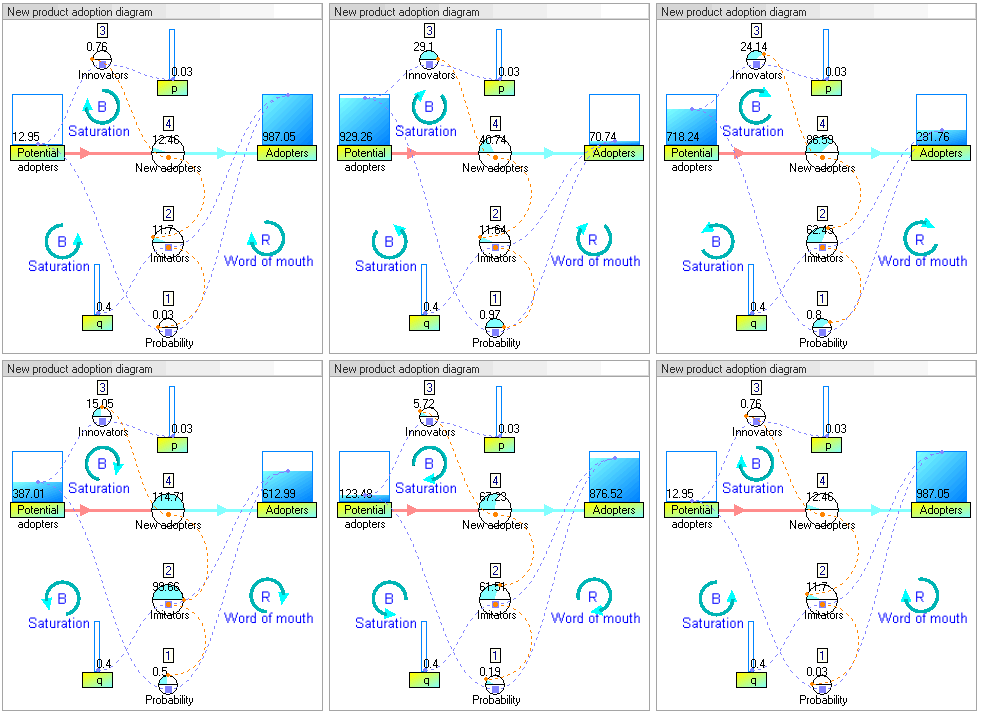
Stock and flow diagrams are a key tool in system dynamics, used to model the dynamics of complex systems. These diagrams consist of stocks (accumulations of material or information), flows (rates of change of the stocks), and feedback loops. By creating a stock and flow diagram, system dynamics modelers can visualize the structure and behaviour of a complex system and identify key leverage points for intervention. For instance, a stock and flow diagram of a water system might include stocks of water storage and flows of water inflow and water outflow. The diagram might also include feedback loops between water level and water usage.
📝 Table Functions and Equations
Table functions and equations are used in system dynamics to model the relationships between different components of a complex system. These functions and equations can be used to describe a wide range of phenomena, from the growth of populations to the flow of materials through a supply chain. By using table functions and equations, system dynamics modelers can create detailed and realistic models of complex systems that can be used to analyze and understand their behaviour. For example, a system dynamics model of a population growth might use a table function to describe the relationship between birth rate and death rate. The model might also use an equation to describe the relationship between population size and resource availability.
🔍 Applications of System Dynamics
System dynamics has a wide range of applications, from business and economics to environmental science and social science. By modeling complex systems and analyzing their behaviour, system dynamics can help us understand and address a wide range of challenges, from climate change to poverty and inequality. For instance, a system dynamics model of a healthcare system might be used to analyze the impact of different healthcare policies on health outcomes. The model might also be used to identify key leverage points for improving the efficiency and effectiveness of the healthcare system.
📊 Case Studies and Examples
There are many case studies and examples of system dynamics in action, from the Club of Rome's famous study of the limits to growth to more recent applications in fields such as sustainability and resilience. These case studies demonstrate the power and flexibility of system dynamics as a tool for understanding and addressing complex challenges. For example, a system dynamics model of a food system might be used to analyze the impact of different agricultural policies on food security. The model might also be used to identify key leverage points for improving the sustainability and resilience of the food system.
🤔 Limitations and Criticisms
Despite its many strengths, system dynamics also has some limitations and criticisms. One of the main challenges is the difficulty of modeling complex systems in a way that is both realistic and tractable. System dynamics models can be highly complex and difficult to understand, which can make it challenging to communicate their results to non-technical stakeholders. Additionally, system dynamics models are only as good as the data and assumptions that go into them, which can be a limitation in fields where data is scarce or uncertain. For instance, a system dynamics model of a financial system might be limited by the availability and quality of financial data.
📚 History and Development
The history and development of system dynamics is a fascinating story that reflects the evolving understanding of complex systems and their behaviour. From its roots in the early 20th century to the present day, system dynamics has been shaped by the contributions of many pioneers and innovators, including Jay Forrester and Donella Meadows. By studying the history and development of system dynamics, we can gain a deeper understanding of the field and its potential for addressing complex challenges. For example, the development of system dynamics was influenced by the systems thinking movement, which emphasized the importance of understanding complex systems as integrated wholes.
📢 Future Directions and Research
As we look to the future, it is clear that system dynamics will continue to play a critical role in addressing complex challenges and creating a more sustainable and resilient world. From climate change to sustainable development, system dynamics provides a powerful tool for analyzing and understanding the complex systems that shape our world. By continuing to develop and apply system dynamics, we can create a brighter future for all. For instance, system dynamics might be used to analyze the impact of different energy policies on greenhouse gas emissions. The model might also be used to identify key leverage points for reducing emissions and mitigating the impacts of climate change.
👥 Key Players and Influencers
There are many key players and influencers in the field of system dynamics, from Jay Forrester and Donella Meadows to more recent contributors such as John Sterman and Peter Senge. By studying the work and ideas of these individuals, we can gain a deeper understanding of the field and its potential for addressing complex challenges. For example, the work of Donella Meadows on limits to growth has had a lasting impact on the field of system dynamics and continues to influence research and practice today.
Key Facts
- Year
- 1950
- Origin
- MIT
- Category
- Complex Systems
- Type
- Concept
Frequently Asked Questions
What is system dynamics?
System dynamics is an approach to understanding the nonlinear behaviour of complex systems over time using stocks, flows, internal feedback loops, table functions and time delays. It was developed in the 1950s by Jay Forrester and has since been applied to a wide range of fields, including economics, environmental science, and social science.
What are the key components of a system dynamics model?
The key components of a system dynamics model include stocks, flows, feedback loops, and delays. Stocks are accumulations of material or information, flows are rates of change of the stocks, and feedback loops occur when the output of a system is fed back into the system as an input. Delays occur when there is a time lag between the input and output of a system.
What are some common applications of system dynamics?
System dynamics has a wide range of applications, from business and economics to environmental science and social science. It can be used to analyze and understand complex systems, identify key leverage points for intervention, and develop strategies for addressing complex challenges.
What are some limitations of system dynamics?
Despite its many strengths, system dynamics also has some limitations and criticisms. One of the main challenges is the difficulty of modeling complex systems in a way that is both realistic and tractable. System dynamics models can be highly complex and difficult to understand, which can make it challenging to communicate their results to non-technical stakeholders.
Who are some key players and influencers in the field of system dynamics?
There are many key players and influencers in the field of system dynamics, from Jay Forrester and Donella Meadows to more recent contributors such as John Sterman and Peter Senge. By studying the work and ideas of these individuals, we can gain a deeper understanding of the field and its potential for addressing complex challenges.
What is the future of system dynamics?
As we look to the future, it is clear that system dynamics will continue to play a critical role in addressing complex challenges and creating a more sustainable and resilient world. From climate change to sustainable development, system dynamics provides a powerful tool for analyzing and understanding the complex systems that shape our world.
How can I learn more about system dynamics?
There are many resources available for learning more about system dynamics, including books, articles, and online courses. Some recommended resources include The Limits to Growth by Donella Meadows, Thinking in Systems by Donella Meadows, and the System Dynamics Society website.