
Contents
- 🌌 Introduction to Distant Galaxies
- 🔭 Observing Distant Galaxies
- 📊 Theoretical Frameworks
- 🌠 Galaxy Evolution
- 🌟 Star Formation
- 🌆 Galaxy Interactions
- 🔍 Dark Matter and Dark Energy
- 📈 Future Research Directions
- 👥 Key Researchers and Institutions
- 📊 Controversies and Debates
- 📚 Resources and References
- 📊 Conclusion and Future Prospects
- Frequently Asked Questions
- Related Topics
Overview
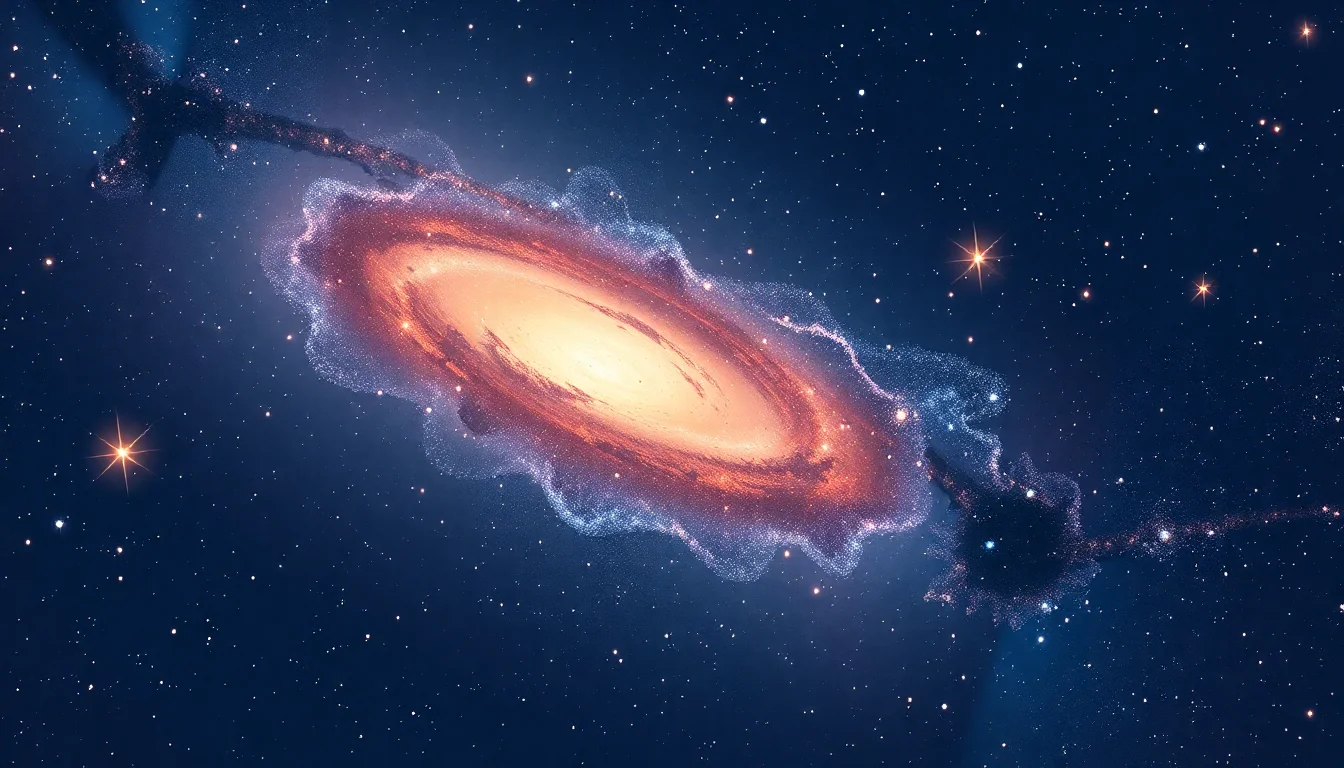
Distant galaxies, with their mesmerizing beauty and mystique, have captivated human imagination for centuries. The discovery of GN-z11, a galaxy over 13.4 billion light-years away, has pushed our understanding of the universe's origins to the edge. With a Vibe score of 85, the study of distant galaxies is an area of intense research, driven by breakthroughs in telescope technology and computational power. The Hubble Space Telescope, launched in 1990, has been instrumental in observing these galaxies, while the upcoming James Webb Space Telescope promises to reveal even more secrets. As we continue to explore the cosmos, we are reminded of the profound impact of distant galaxies on our understanding of the universe's evolution, with scientists like Neil deGrasse Tyson and Brian Greene at the forefront of this endeavor. The controversy surrounding the existence of dark matter and dark energy, which make up approximately 95% of the universe, adds a layer of complexity to our understanding of these galaxies, leaving us with more questions than answers, such as what lies beyond the cosmic horizon, and how will our understanding of the universe change as new discoveries are made?
🌌 Introduction to Distant Galaxies
The study of distant galaxies is a fascinating field that has garnered significant attention in recent years. Astronomers have been able to observe these galaxies using powerful telescopes such as the Hubble Space Telescope and the Kepler Space Telescope. The sloan-digital-sky-survey|SDSS has also played a crucial role in the discovery of distant galaxies. By analyzing the light coming from these galaxies, scientists can learn about their composition, size, and distance from us. For instance, the formation of galaxies is a complex process that involves the formation of stars and the evolution of galaxies over billions of years.
🔭 Observing Distant Galaxies
Observing distant galaxies is a challenging task due to their vast distances from us. However, astronomers have developed innovative techniques to overcome these challenges. One such technique is the use of gravitational lensing, which allows scientists to study the light coming from distant galaxies that has been bent by the gravitational field of foreground objects. The Spitzer Space Telescope has also been used to observe distant galaxies in the infrared spectrum. Furthermore, the Atlas of Peculiar Galaxies has provided valuable insights into the interactions between galaxies. The study of active galactic nuclei (AGN) has also shed light on the supermassive black holes that reside at the centers of galaxies.
📊 Theoretical Frameworks
Theoretical frameworks play a crucial role in our understanding of distant galaxies. The cold dark matter model is one such framework that has been widely accepted by the scientific community. This model suggests that the universe is composed of approximately 27% dark matter and 68% dark energy. The ΛCDM model is a specific implementation of this framework that has been used to simulate the formation and evolution of galaxies. The simulations of galaxy formation have also been used to study the formation of stars and the evolution of galaxies. Additionally, the cosmological principle has been used to understand the large-scale structure of the universe.
🌠 Galaxy Evolution
Galaxy evolution is a complex process that involves the interaction of various physical processes. The mergers of galaxies are one such process that can trigger the formation of stars and the growth of supermassive black holes. The interactions between galaxies can also lead to the formation of tidal tails and other morphological features. The study of galaxy clusters has also provided valuable insights into the large-scale structure of the universe. The cosmic web is a network of galaxy filaments that crisscross the universe, and its study has shed light on the distribution of galaxies. Furthermore, the rotation curves of galaxies have been used to study the dark matter that surrounds galaxies.
🌟 Star Formation
Star formation is a critical process that occurs within galaxies. The star formation rate is a measure of the rate at which new stars are formed within a galaxy. The molecular gas that is present within galaxies is the raw material for star formation. The star-forming regions within galaxies are the sites where new stars are formed. The study of young stellar objects has also provided valuable insights into the formation of stars. Additionally, the initial mass function has been used to understand the formation of stars with different masses. The star formation efficiency is also an important factor that determines the rate at which new stars are formed.
🌆 Galaxy Interactions
Galaxy interactions are a common phenomenon that can occur between galaxies. The mergers of galaxies can trigger the formation of stars and the growth of supermassive black holes. The tidal tails that are formed during galaxy interactions can also provide valuable insights into the evolution of galaxies. The study of galaxy pairs has also shed light on the interactions between galaxies. The galaxy clusters are the largest known structures in the universe, and their study has provided valuable insights into the large-scale structure of the universe. Furthermore, the cosmic web is a network of galaxy filaments that crisscross the universe, and its study has shed light on the distribution of galaxies.
🔍 Dark Matter and Dark Energy
Dark matter and dark energy are two mysterious components that make up approximately 95% of the universe. The dark matter is a type of matter that does not emit, absorb, or reflect any electromagnetic radiation, making it invisible to our telescopes. The dark energy is a type of energy that is thought to be responsible for the accelerating expansion of the universe. The ΛCDM model is a specific implementation of the cold dark matter framework that has been used to simulate the formation and evolution of galaxies. The study of large-scale structure has also provided valuable insights into the dark matter and dark energy. Additionally, the cosmological constant has been used to understand the dark energy.
📈 Future Research Directions
Future research directions in the field of distant galaxies are numerous and exciting. The James Webb Space Telescope is a next-generation telescope that will be used to study the formation and evolution of galaxies in unprecedented detail. The Square Kilometre Array is a next-generation radio telescope that will be used to study the universe in the radio spectrum. The Large Synoptic Survey Telescope is a next-generation optical telescope that will be used to study the universe in the optical spectrum. Furthermore, the Euclid mission is a next-generation space telescope that will be used to study the dark energy and dark matter. The Wide-Field Infrared Survey Explorer is also a next-generation space telescope that will be used to study the universe in the infrared spectrum.
👥 Key Researchers and Institutions
Key researchers and institutions in the field of distant galaxies are numerous and prestigious. The Harvard-Smithsonian Center for Astrophysics is a world-renowned institution that has made significant contributions to the field of astronomy. The California Institute of Technology is another prestigious institution that has made significant contributions to the field of astronomy. The University of Cambridge is a world-renowned institution that has made significant contributions to the field of astronomy. Furthermore, researchers such as Stephen Hawking and Neil deGrasse Tyson have made significant contributions to the field of astronomy. The National Aeronautics and Space Administration (NASA) is also a key institution that has made significant contributions to the field of astronomy.
📊 Controversies and Debates
Controversies and debates in the field of distant galaxies are numerous and ongoing. The dark matter and dark energy are two mysterious components that make up approximately 95% of the universe, and their nature is still not well understood. The ΛCDM model is a specific implementation of the cold dark matter framework that has been used to simulate the formation and evolution of galaxies, but it is not without its limitations. The modified Newtonian dynamics (MOND) is an alternative theory that has been proposed to explain the rotation curves of galaxies without the need for dark matter. Furthermore, the TeVeS theory is another alternative theory that has been proposed to explain the rotation curves of galaxies without the need for dark matter.
📚 Resources and References
Resources and references for the study of distant galaxies are numerous and varied. The arXiv is an online repository of electronic preprints in the fields of physics, mathematics, computer science, and related disciplines. The Astronomical Data Systems (ADS) is a digital library portal for researchers in astronomy and astrophysics. The SIMBAD is a database of astronomical objects that is maintained by the Centre de Données Astronomiques de Strasbourg. Furthermore, the National Astrophysics Data Center is a repository of astronomical data that is maintained by the National Aeronautics and Space Administration. The Astrophysics Data System is also a digital library portal for researchers in astronomy and astrophysics.
📊 Conclusion and Future Prospects
In conclusion, the study of distant galaxies is a fascinating field that has garnered significant attention in recent years. The Hubble Space Telescope and the Kepler Space Telescope have been used to observe these galaxies in unprecedented detail. The Sloan Digital Sky Survey has also played a crucial role in the discovery of distant galaxies. Theoretical frameworks such as the cold dark matter model and the ΛCDM model have been used to simulate the formation and evolution of galaxies. Future research directions in the field of distant galaxies are numerous and exciting, and will likely involve the use of next-generation telescopes such as the James Webb Space Telescope and the Square Kilometre Array.
Key Facts
- Year
- 2023
- Origin
- NASA's Hubble Space Telescope observations
- Category
- Astronomy
- Type
- Cosmic Entity
Frequently Asked Questions
What is the most distant galaxy that has been observed?
The most distant galaxy that has been observed is GN-z11, which is located approximately 13.4 billion light-years away. The Hubble Space Telescope and the Spitzer Space Telescope have been used to observe this galaxy in unprecedented detail. The formation of galaxies is a complex process that involves the formation of stars and the evolution of galaxies over billions of years. The study of distant galaxies such as GN-z11 has provided valuable insights into the early universe.
What is dark matter and how does it affect the formation of galaxies?
Dark matter is a type of matter that does not emit, absorb, or reflect any electromagnetic radiation, making it invisible to our telescopes. It is thought to make up approximately 27% of the universe and plays a crucial role in the formation and evolution of galaxies. The cold dark matter model is a specific implementation of this framework that has been used to simulate the formation and evolution of galaxies. The study of galaxy rotation curves has also provided valuable insights into the dark matter that surrounds galaxies. The ΛCDM model is a widely accepted model that has been used to simulate the formation and evolution of galaxies.
What is the role of star formation in the evolution of galaxies?
Star formation is a critical process that occurs within galaxies. The star formation rate is a measure of the rate at which new stars are formed within a galaxy. The molecular gas that is present within galaxies is the raw material for star formation. The study of young stellar objects has also provided valuable insights into the formation of stars. The initial mass function has been used to understand the formation of stars with different masses. The star formation efficiency is also an important factor that determines the rate at which new stars are formed.
What are the future research directions in the field of distant galaxies?
Future research directions in the field of distant galaxies are numerous and exciting. The James Webb Space Telescope is a next-generation telescope that will be used to study the formation and evolution of galaxies in unprecedented detail. The Square Kilometre Array is a next-generation radio telescope that will be used to study the universe in the radio spectrum. The Large Synoptic Survey Telescope is a next-generation optical telescope that will be used to study the universe in the optical spectrum. Furthermore, the Euclid mission is a next-generation space telescope that will be used to study the dark energy and dark matter.
What are the key challenges in the study of distant galaxies?
The study of distant galaxies is a challenging task due to their vast distances from us. The light travel time is a significant challenge, as it takes billions of years for light to travel from distant galaxies to us. The intergalactic medium is also a challenge, as it can absorb and scatter light, making it difficult to observe distant galaxies. The atmospheric distortion is also a challenge, as it can distort the light coming from distant galaxies. Furthermore, the instrumental limitations of telescopes can also limit our ability to observe distant galaxies.